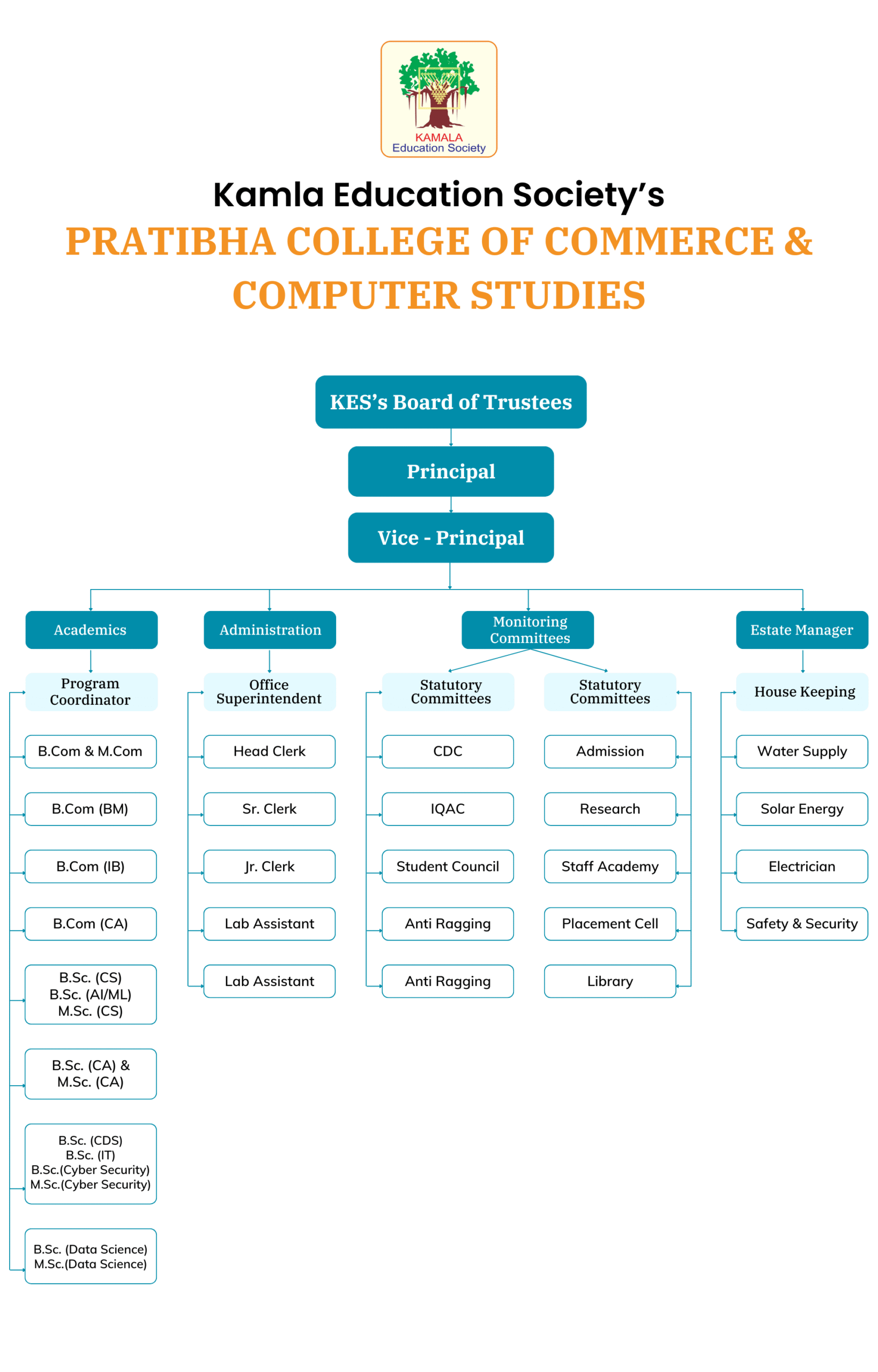





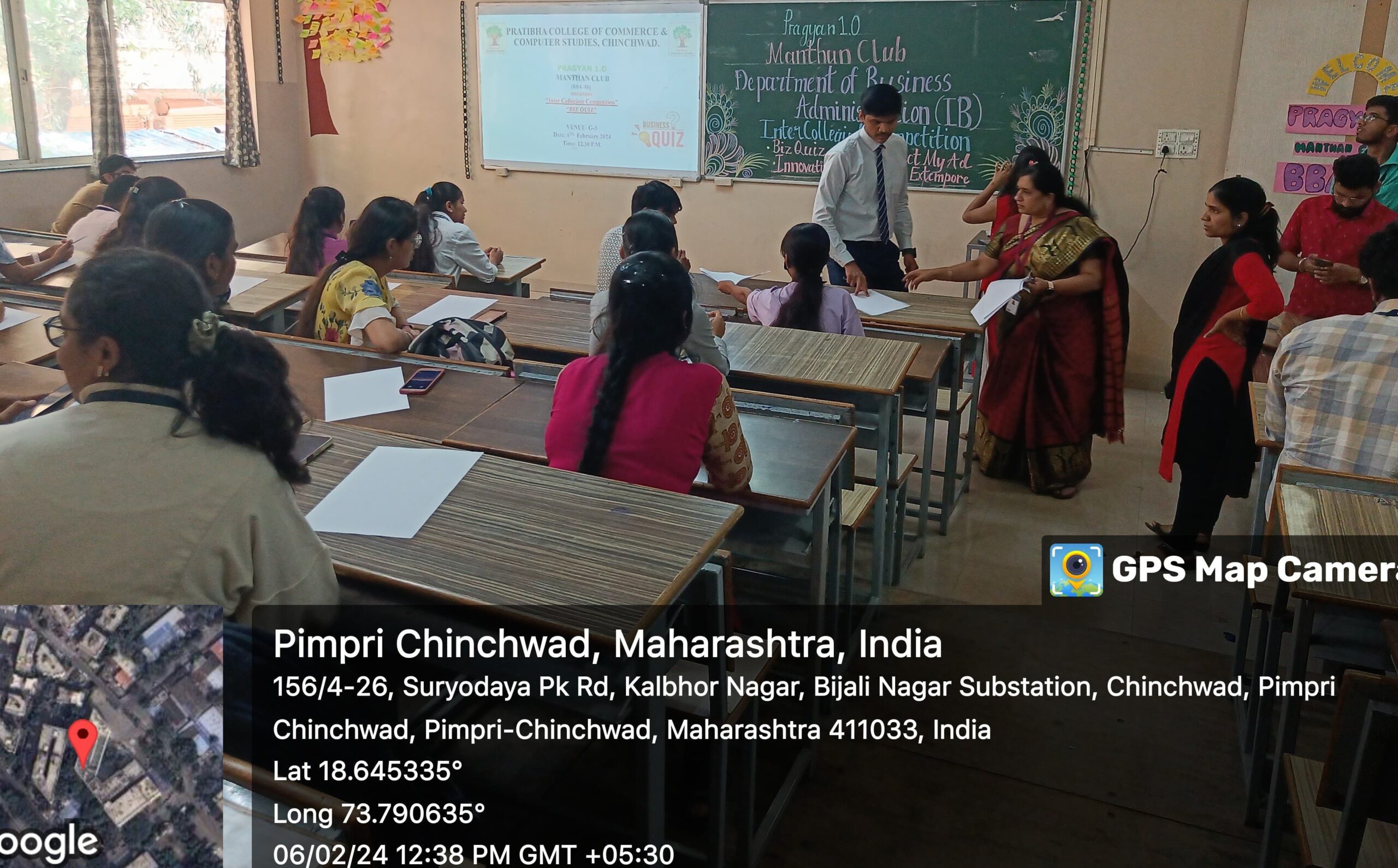
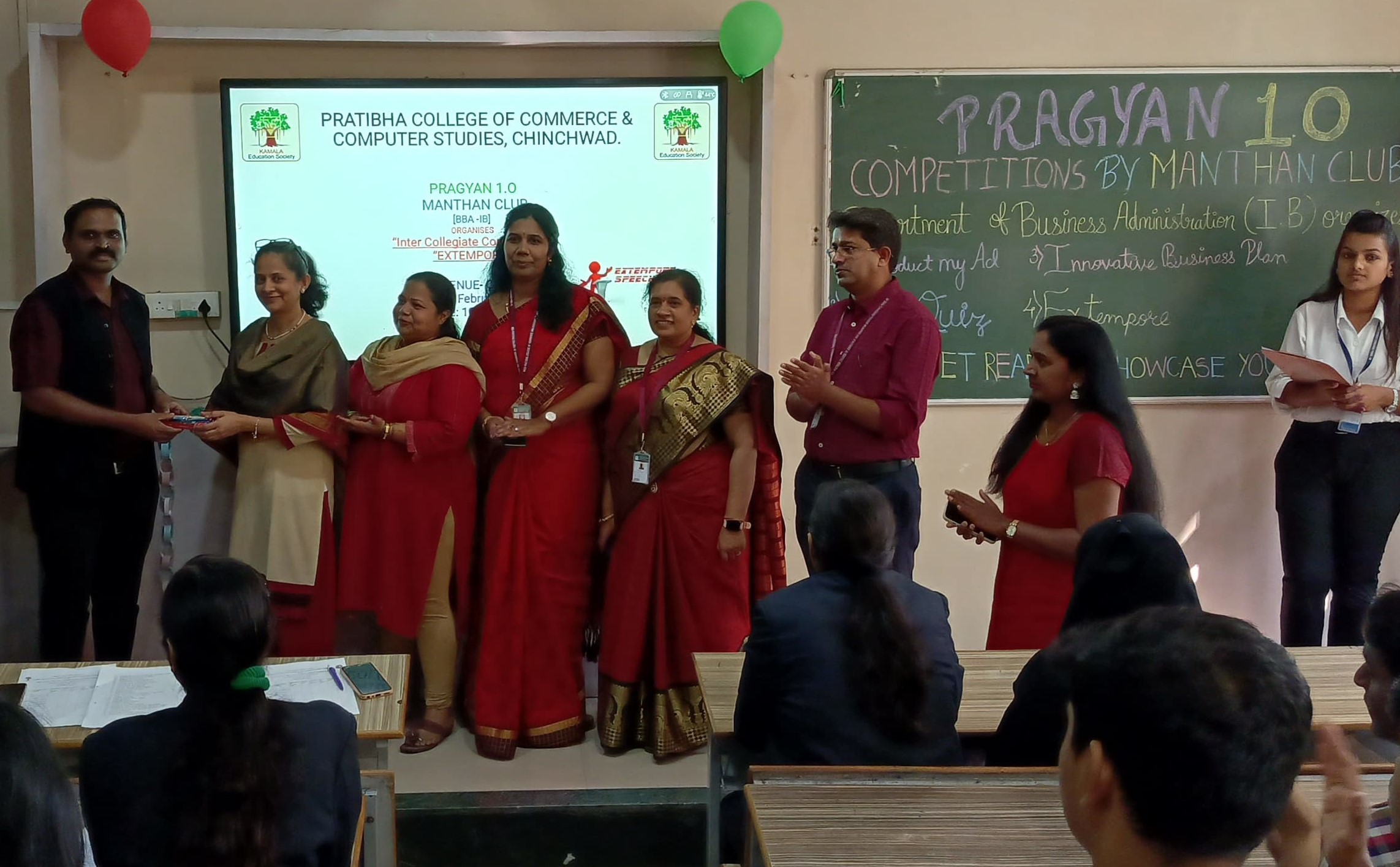


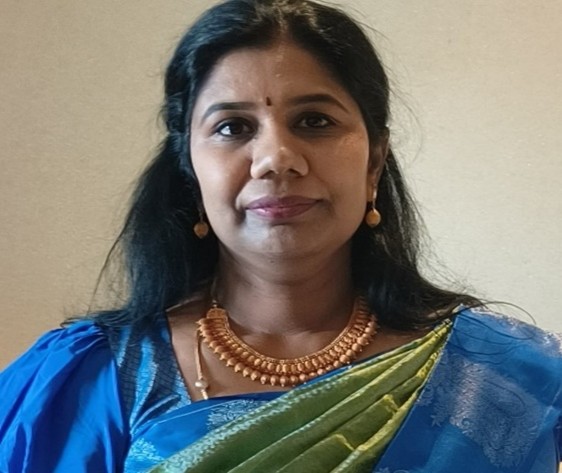


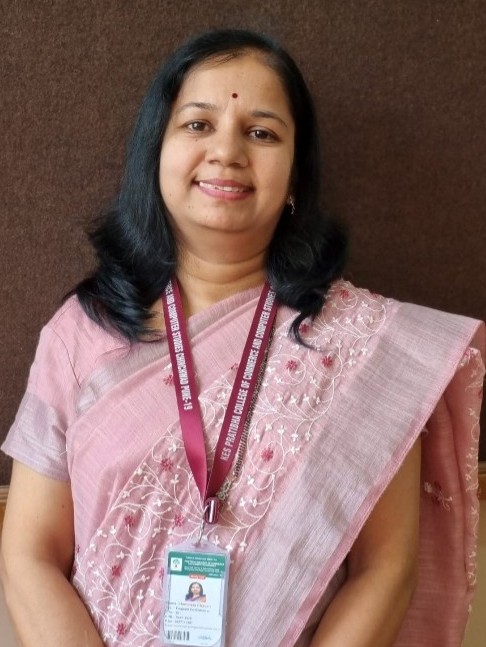


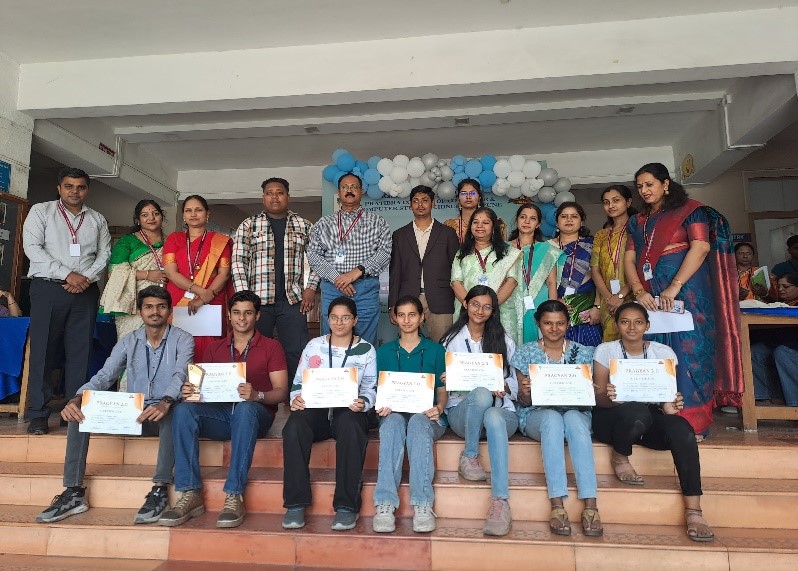
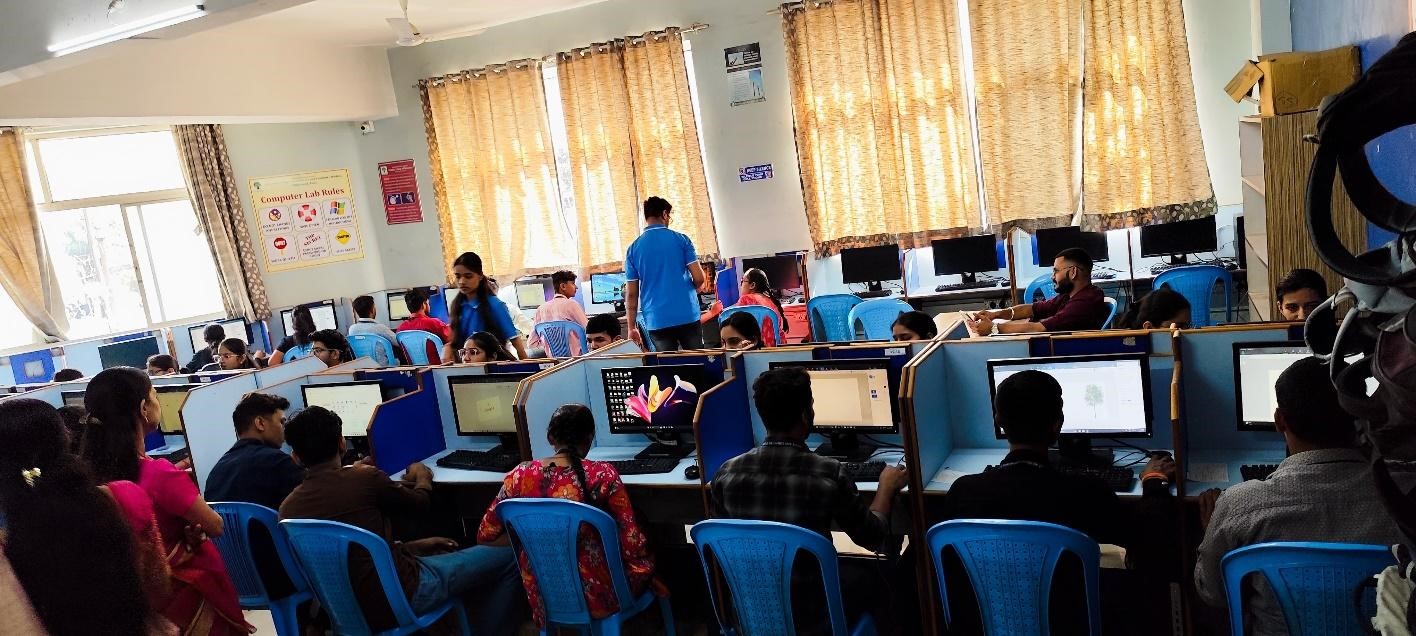
The Department of Commerce at Pratibha College of Commerce & Computer Studies (PCCCS) is a well-established program offering undergraduate and postgraduate courses. The department was founded in 2008 with 20 students and has seen significant growth, now having over 1000 students. It provides courses like B.Com, M.Com. and Ph. D. and has been recognized for its strong faculty members, which includes 5 Ph. D. degree holders and 4 NET/SET qualified faculty members.
Objectives:
Special Features:
Activities of Commerce Association
Signature Activities:
Courses offered
Year of Establishment- 2008
Affiliated to – Savitribai Phule Pune University
Intake: B.Com.- 840
M.Com.- 120
Ph.D.- 12
a) No Candidates shall be admitted to the First Year of the B.Com Degree Program (2024 Pattern) unless he / she has passed the Higher Secondary School Certificate Examination of the Maharashtra State Board or equivalent or University with English as a passing Course.
b) No candidate shall be admitted to the Third Semester Examination of the Second Year unless he / she has cleared First Two Semesters satisfactorily for the course at the college affiliated to this University.
c) No student shall be admitted to the Third Year B.Com (Fifth Semester) Degree Program (2024 Pattern) unless he / she has cleared all the papers of First and Second Semester Examination of F.Y. B.Com.
d) No candidate shall be admitted to the Fifth Semester Examination of the Third Year unless he / she has cleared first Two Semesters satisfactorily of Second Year for the Program at the college affiliated to this University.
e.) No candidate shall be admitted to the Fourth Year B.Com (Seventh Semester)Degree program (2024 pattern) unless he/she has cleared all the papers of Third and Fourth Semester examination of S.Y. B.Com.
| Sr. No. | Qualification Title | Credit requirement | Semester | Year | |
|---|---|---|---|---|---|
| Minimum | Maximum | ||||
| 1 | UG Certificate | 40 | 44 | 2 | 1 |
| 2 | UG Diploma | 80 | 88 | 4 | 2 |
| 3 | Three year Bachelor’s Degree | 120 | 132 | 6 | 3 |
| 4 | Four year Bachelor’s Degree | 160 | 176 | 8 | 4 |
| Year | Term I | Term II | Total |
|---|---|---|---|
| Total Credit | Total Credit | Term I + Term II | |
| First | 22 | 22 | 44 |
| Second | 22 | 22 | 44 |
| Third | 22 | 22 | 44 |
| Fourth | 22 | 22 | 44 |
| Total | 176 | ||
| Semester | Course Type | Course Name/Course Title | Total Credits |
|---|---|---|---|
| I | DSC I | Fundamentals of Marketing-I | 4 |
| I | DSC II | Fundamentals of Banking -I / Basics of Cost and Management Accounting and Material Accounting-I | 4 |
| I | DSC III | Introduction to Behavioral Economics | 4 |
| I | OE | Basic Mathematics-I or Google Apps-I | 2 |
| I | SEC | Business Accounting-I | 2 |
| I | AEC | English-I | 2 |
| I | VEC | Environmental Science | 2 |
| I | IKS | Indian Knowledge System | 2 |
| Total Credits: | 22 | ||
| Semester | Course Type | Course Name/Course Title | Total Credits |
|---|---|---|---|
| II | DSC I | Fundamentals of Marketing-II | 4 |
| II | DSC II | Fundamentals of Insurance-II/ Inventory, Labour, and Overhead Accounting-II | 4 |
| II | DSC III | Market Structure and Welfare Economics | 4 |
| II | OE | Basic Mathematics-II or Google Apps-II | 2 |
| II | SEC | Business Accounting-II | 2 |
| II | AEC | English-II | 2 |
| II | VEC | Constitutional Values, Fundamental Duties and Political System in India | 2 |
| II | CC | Health and Wellness OR Cultural Activities OR NSS (National Service Scheme) | 2 |
| Total Credits: | 22 | ||
| Semester | Course Type | Course Name/Course Title | Total Credits |
|---|---|---|---|
| III | MJ | Corporate Accounting-I | 4 |
| III | MJ | Indian Banking System-I /Methods of Costing-I | 2 |
| III | MN | Macro Economics | 4 |
| III | OE | Mathematics for Competitive Exam-I / Digital Marketing-I | 2 |
| III | VSC | Computerised Accounting-I | 2 |
| III | AEC | Marathi-I / Hindi-I | 2 |
| III | IKS | Ancient Banking Systems in India / Costing Systems in Ancient India | 2 |
| III | CC | Health and Wellness OR Cultural Activities OR NSS (National Service Scheme) | 2 |
| III | FP | Field Project in Banking, Finance and Insurance / Field Project in Cost and Management Accounting | 2 |
| Total Credits: | 22 | ||
| Semester | Course Type | Course Name/Course Title | Total Credits |
|---|---|---|---|
| IV | MJ | Corporate Accounting-II | 4 |
| IV | MJ | Indian Banking System-II /Methods of Costing-II | 2 |
| IV | MN | Macro Economics Policy | 4 |
| IV | OE | Mathematics for Competitive Exam-I / Digital Marketing-I | 2 |
| IV | VSC | Tally Accounting-II | 2 |
| IV | AEC | Marathi-II / Hindi-II | 2 |
| IV | IKS | Ancient Banking Systems in India / Costing Systems in Ancient India | 2 |
| IV | CC | To be selected from university basket – Health and Wellness, Yoga Education OR Sports and Fitness OR Cultural Activities OR NSS (National Service Scheme) OR NCC (National Cadet Corpse) OR Cultural Activities | 2 |
| IV | CEP-I | Community Engagement Project-I (Major related) | 2 |
| Total Credits: | 22 | ||
| Semester | Course Type | Course Name/Course Title | Total Credits |
|---|---|---|---|
| V | MM | Auditing and Ethics | 4 |
| V | MM | Company Law | 4 |
| V | MM | Financial Markets and Institutions / Techniques of Costing-I | 4 |
| V | ME | Business Regulatory Framework-I | 4 |
| V | MN | Indian Economy | 2 |
| V | VSC | IT in Banking and Insurance / Financial Modelling-I | 2 |
| V | FP | Field Project-II / Community Engagement Project-II | 2 |
| Total Credits: | 22 | ||
| Semester | Course Type | Course Name/Course Title | Total Credits |
|---|---|---|---|
| VI | MM | Income Tax | 4 |
| VI | MM | Banking Law and Practice / Techniques of Costing-II | 4 |
| VI | MM | International Economics | 2 |
| VI | ME | Business Regulatory Framework-II | 4 |
| VI | MN | Indian Economy | 2 |
| VI | VSC | Financial Literacy / Financial Modelling-II | 2 |
| VI | OJT | On Job Training | 4 |
| Total Credits: | 22 | ||
After successful completion of B.Com Programme students will be able to:
| PO No. | Outcome | Description |
|---|---|---|
| PO 1 | Accounting Proficiency | Graduates will demonstrate a fundamental understanding of financial, cost, and management accounting principles and practices. They will have the ability to prepare and interpret financial and cost statements accurately. Graduates can apply accounting concepts to record business transactions and analyze financial data effectively. They will be able make decisions related to environmental responsibility in business transactions. |
| PO 2 | Mathematical and Statistical Analysis | Graduates will acquire proficiency in mathematical and statistical concepts and techniques relevant to business applications. They can solve mathematical problems related to commerce and economics, applying quantitative methods for business decisions. They will develop skills in collecting, analyzing, and interpreting data, using statistical software and tools for solving business problems. |
| PO 3 | Technology and Computerized Accounting | Graduates will master the use of accounting software for efficient and accurate financial data management. They can create, manage, and analyze financial records using computerized accounting systems. They understand the importance of data security and integrity in computerized accounting. |
| PO 4 | Communication Skills | Graduates will develop effective communication skills for various business contexts, including written and oral communication. They will be able to present ideas and information clearly and professionally. Graduates can resolve conflicts through effective communication and understand the importance of cultural sensitivity in business communication. |
| PO 5 | Language Proficiency | Graduates will enhance English language proficiency for academic and professional purposes, including reading, writing, and speaking. They can communicate fluently and accurately in written and spoken English. Graduates will apply English language skills effectively in business and academic contexts, using standard grammar and vocabulary. |
| PO 6 | Environmental Awareness | Graduates will understand environmental issues and their impact on business and society. They can analyze environmental factors affecting business decisions and sustainability. |
| PO 7 | Specialized Accounting Knowledge | Graduates will develop a solid foundation in cost and management accounting principles. They can calculate and analyze various costs involved in business operations and apply cost accounting techniques. Graduates will gain expertise in advanced cost and management accounting for strategic decision-making. |
| PO 8 | Financial Reporting and Analysis | Graduates will gain an advanced understanding of financial accounting principles, standards, and regulations. They will be able to analyze complex financial transactions, prepare financial statements and interpret them for stakeholders and investors. Graduates will apply accounting standards and principles for financial reporting in various business contexts. |
| PO 9 | Economic Analysis and Decision-Making | Graduates will understand economic principles and their application in business. They can analyze economic factors affecting business decisions and evaluate economic policies’ impact on the business environment. Graduates will be able to apply economic principles for business strategy and development. |
| PO 10 | International Accounting and Taxation | Graduates will have an understanding of international accounting standards and their application. They can navigate complex tax laws and regulations effectively for businesses and individuals. Graduates will provide specialized tax advice for international and cross-border transactions. |
| PO 11 | Management Accounting and Strategic Decision-Making | Graduates will apply advanced management accounting techniques for strategic decision making. They can analyze cost and performance data to optimize organizational efficiency and develop budgets and forecasts to support organizational goals. Graduates will implement management accounting practices to enhance organizational competitiveness. |
| PO 12 | Ethics and Professionalism | Graduates will demonstrate ethical conduct in accounting and business practices, adhering to professional standards and regulations. They will prioritize accuracy, integrity, and confidentiality in financial reporting and data management. Graduates will communicate ethical principles in business relationships and decision making. |
| CO No. | Course Outcome |
|---|---|
| CO-1 | Acquainted with the basics of marketing field. |
| CO-2 | It will help students to implement this knowledge in practicality by enhancing their skills in the concepts of ‘Marketing Mix’ and Market segmentation. |
| CO-3 | To get the knowledge of Salesmanship and various approaches. |
| CO-4 | To get the knowledge about Recent Trends in marketing area. |
| CO No. | Course Outcome |
|---|---|
| CO-1 | Acquainted with the basics of Banking field. |
| CO-2 | It will help students to implement this knowledge in practicality by enhancing their skills in the concepts of banking. |
| CO-3 | To get the knowledge of banking operations. |
| CO-4 | To get the knowledge about Banking business and practices. |
| CO No. | Course Outcome |
|---|---|
| CO-1 | The students will be able to the Comprehend the Origin of economics. |
| CO-2 | Understand the importance of Indian Knowledge System related to economics. |
| CO-3 | Explore the interdisciplinary approach to economics. |
| CO-4 | Understand the concepts, theory and Laws of Microeconomics. |
| CO-5 | Solve simple mathematical equations related to economics. |
| CO-6 | To develop a logical approach toward analytical approach data. |
| CO No. | Course Outcome |
|---|---|
| CO-1 | To understand the accounting principles, concepts, conventions, and partnership accounts. |
| CO-2 | To apply accounting principles, concepts, conventions, and partnership accounts for accounting treatment. |
| CO-3 | To analyze the effects of accounting treatments. |
| CO-4 | To evaluate the impact of accounting treatments. |
| CO-5 | To create an independent accounting of the financial transactions. |
| CO-6 | To remember the accounting principles, concepts, conventions, and partnership accounts. |
| CO No. | Course Outcome |
|---|---|
| CO-1 | To understand basic concepts of Mathematics. |
| CO-2 | To be able to use the language, symbols, and notation of Mathematics. |
| CO-3 | To develop Mathematical curiosity and acquire skills in problem solving. |
| CO-4 | To develop an appropriate understanding of how to use mathematics in real-world problems. |
| CO-5 | To cultivate the right understanding and regain numerical aptitude. |
| CO No. | Course Outcome |
|---|---|
| CO-1 | Use the Google tools for the day to day life. |
| CO-2 | Explore various applications available in the Google tools. |
| CO-3 | Develop the skills to implement the skills available in the Google tools. |
| CO No. | Course Outcome |
|---|---|
| CO-1 | The concept of the ancient intellectual knowledge tradition will be understood. |
| CO-2 | Developments in science from ancient times will be introduced. |
| CO-3 | Developments in humanities from ancient times will be understood. |
| CO No. | Course Outcome |
|---|---|
| CO-1 | Students understand the importance of communication and the consequent competence required for it. |
| CO-2 | Students learn the basics of communication. |
| CO-3 | Students acquire the necessary skills components of communication. |
| CO-4 | Students become confident about communication through rigorous exercise. |
| CO-5 | Students become competent in communication. |
| CO-6 | Students realize that literary pieces are very good examples of effective communication. |
| CO No. | Course Outcome |
|---|---|
| CO-1 | Describe how human activities impact the environment. |
| CO-2 | Explain principles of sustainable development and resource management. |
| CO-3 | Analyze local, regional, and global environmental issues and their effects. |
| CO-4 | Evaluate different strategies for conserving biodiversity and ecosystems. |
| CO-5 | Apply relevant environmental policies and ethical considerations to real-world scenarios. |
| CO-6 | Design and implement action plans for community-based environmental projects. |
| CO No. | Course Outcome |
|---|---|
| CO-1 | Understand the fundamentals of the marketing and sales process. |
| CO-2 | Apply practical knowledge by enhancing skills in key concepts such as the “Marketing Mix” and market segmentation. |
| CO-3 | Gain insights into salesmanship and explore various sales approaches. |
| CO-4 | Acquire knowledge about recent trends and innovations in the marketing field. |
| CO No. | Course Outcome |
|---|---|
| CO-1 | The concepts related to Material and Labour as an element of cost. |
| CO-2 | The Cost Accounting Standards related to Material and Labour as an element of cost. |
| CO-3 | Various techniques of Material (Inventory) cost control and Labour cost control. |
| CO-4 | The Stores related documents and payroll system. |
| CO-5 | The effectiveness of various techniques under Material and Labour accounting. |
| CO No. | Course Outcome |
|---|---|
| CO-1 | Understand the fundamentals of the Insurance. |
| CO-2 | Apply practical knowledge by enhancing skills in key concepts of Insurance Business. |
| CO-3 | Understand difference between life and general insurance. |
| CO-4 | Acquire knowledge about recent trends in Insurance sector. |
| CO No. | Course Outcome |
|---|---|
| CO-1 | Understand perfect and imperfect market structure. |
| CO-2 | Understand Indian Knowledge System related to competitive market structure. |
| CO-3 | Explore the relationship between micro economics and welfare economics. |
| CO-4 | Understand measures of microeconomic concepts and theory. |
| CO-5 | Solve simple case studies related to imperfect market. |
| CO No. | Course Outcome |
|---|---|
| CO-1 | To understand the concepts, meaning, fundamental principles, types, and legislation in India and Maharashtra of Co-Operation, and meaning and classification of branches. |
| CO-2 | To apply concepts of Co-Operation and Classification of Branches for accounting treatment. |
| CO-3 | To analyze the financial statements and ledgers. |
| CO-4 | To evaluate the impact of accounting treatments. |
| CO-5 | To create an independent accounting of the financial transactions. |
| CO-6 | To remember the concept of Co-Operation and Branch. |
| CO No. | Course Outcome |
|---|---|
| CO-1 | Students understand the importance of communication and the consequent competence required for it. |
| CO-2 | Students learn the basics of communication. |
| CO-3 | Students acquire the necessary skills components of communication. |
| CO-4 | Students become confident about communication through rigorous exercise. |
| CO-5 | Students become competent in communication. |
| CO-6 | Students realize that literary pieces are very good examples of effective communication. |
| CO No. | Course Outcome |
|---|---|
| CO-1 | To understand the concepts of Time, Work and Wages also be able to logical approach towards analytical approach data of real word problem. |
| CO-2 | To understand concepts of Linear Equations and ability to solve examples in finding Age in past and future. |
| CO-3 | To understand concepts of Simple and Compound Interest and to develop Mathematical Competence. |
| CO-4 | To understand concepts of Mensuration and able to develop Mathematical competence in solving Problems. |
| CO-5 | To provide a platform for the students to build the fundamentals of Basic Mathematics for competitive examination preparation strategy. |
| CO-6 | To establish a framework for the students to help acquire the knowledge and expertise necessary to secure employment opportunities in the government sector. |
| CO No. | Course Outcome |
|---|---|
| CO-1 | Use the Google tools for the day to day life. |
| CO-2 | Explore various applications available in the Google tools. |
| CO-3 | Develop the skills to implement the skills available in the Google tools. |
| CO No. | Course Outcome |
|---|---|
| CO-1 | Understand the process of making of Constitution and its features. |
| CO-2 | Appreciate the Constitutional values and understand the importance of fundamental duties enshrined in the Constitution of India. |
| CO-3 | Understand the dynamics of the political System in India, recent trends, challenges and cleavages of the Indian political system so as to get inspiration to cherish the values embedded in the Constitution. |
| CO No. | Course Outcome |
|---|---|
| CO-1 | Understand the concepts of the Pre and Post of Incorporation Period, Internal Reconstruction, Statutory provisions regarding preparation of Financial Statements of Company, and Liquidation. |
| CO-2 | Apply the knowledge of Pre and Post of Incorporation Period, Internal Reconstruction, Statutory provisions regarding preparation of Financial Statements of Company, and Liquidation. |
| CO-3 | Analyze the effects of accounting treatments of Pre and Post of Incorporation Period, Internal Reconstruction, Statutory provisions regarding preparation of Financial Statements of Company, and Liquidation. |
| CO-4 | Evaluate the impact of Pre and Post of Incorporation Period, Internal Reconstruction, Statutory provisions regarding preparation of Financial Statements of Company, and Liquidation. |
| CO-5 | Create an accounting of the Pre and Post of Incorporation Period, Internal Reconstruction, Statutory provisions regarding preparation of Financial Statements of Company, and Liquidation. |
| CO-6 | Remember the accounting treatment of Pre and Post of Incorporation Period, Internal Reconstruction, Statutory provisions regarding preparation of Financial Statements of Company, and Liquidation. |
| CO No. | Course Outcome |
|---|---|
| CO-1 | Remember the concepts related to Methods of Costing. |
| CO-2 | Understand the application of Cost Accounting in different manufacturing industries. |
| CO-3 | Apply the skills of Cost Accounting in different manufacturing industries. |
| CO-4 | Analyze the reasons leading to increase in cost of Job and Contract. |
| CO-5 | Evaluate the estimated and actual cost for a job and contract. |
| CO No. | Course Outcome |
|---|---|
| CO-1 | Explain the historical development of banking in India, including major milestones such as nationalization and economic reforms. |
| CO-2 | Identify and distinguish the various types of banks in India, their roles, ownership structures, and functions within the financial system. |
| CO-3 | Demonstrate an in-depth understanding of the Reserve Bank of India, its objectives, governance, and regulatory responsibilities. |
| CO-4 | Understanding the various functions of the RBI will help in realizing its importance in the Indian banking sector. |
| CO-5 | Evaluate the tools and objectives of the RBI’s monetary policy, and understand how it impacts inflation, economic growth, and credit availability. |
| CO-6 | Critically assess the RBI’s interventions during financial emergencies, especially its policies aimed at stabilizing the Indian economy during and after the COVID-19 pandemic. |
| CO-7 | Apply theoretical knowledge to real-world financial scenarios, thereby developing the analytical and decision-making skills required in banking and financial services. |
| CO No. | Course Outcome |
|---|---|
| CO-1 | Know the concepts of various macroeconomics concepts. |
| CO-2 | To comprehend the measurement of National Income Accounting. |
| CO-3 | Understand fluctuations in the economy through Business Cycle. |
| CO-4 | Understand the relevance of macro-economic policy of Keynes and others. |
| CO No. | Course Outcome |
|---|---|
| CO-1 | Understand the meaning, concepts, importance and need of Computerized Accounting in the Accounting Information System. |
| CO-2 | Apply the Tally Accounting Software for Accounting of Business Transactions and generating of various Reports. |
| CO-3 | Analyse the components of Tally Software for Computerized Accounting. |
| CO-4 | Evaluate the Manual and Computerized Accounting. |
| CO-5 | Create New Company and Group of New Company with necessary Features and Configuration in the Tally Software. |
| CO-6 | Remembers all the features of Tally Software and its application for computerized Accounting. |
| CO No. | Course Outcome |
|---|---|
| CO-1 | Remember the Journey of Indian Accounting Practices. |
| CO-2 | Analyse Indian System of Cost and Management Accounting. |
| CO-3 | Apply the concepts of labour, expenses and funds in Indian Vedic Texts. |
| CO No. | Course Outcome |
|---|---|
| CO-1 | Acquaint with the Banking Practices during the Vedic, Mauryan and Gupta periods. |
| CO-2 | Understand the working of Guilds (Sreni), Temples and Moneylenders (Shroffs) as the Banking Institutions. |
| CO-3 | Know about the practical details about the traditional Financial Instruments like Hundi, Akshaya Patra, Metallic Coinage, etc. |
| CO No. | Course Outcome |
|---|---|
| CO-1 | Apply various concepts learned in the classrooms to real-world socio-economic contexts, thereby enhancing their understanding, practical skills, and decision-making abilities. |
| CO-2 | Demonstrate awareness and insights into the cultural, economic, and social diversity of communities, preparing them to act as responsible, inclusive, and informed citizens. |
| CO-3 | Analyse field data to showcase research aptitude, critical thinking, and ethical conduct in handling socio-economic issues using appropriate statistical tools and methodologies. |
| CO-4 | Evaluate complex real-life situations to make informed and evidence-based decisions using problem-solving strategies and critical thinking. |
| CO-5 | Collaborate effectively in diverse teams to achieve shared project goals, demonstrating interpersonal skills, coordination, and collective responsibility. |
| CO-6 | Exhibit professional integrity and ethical standards in all field interactions, upholding honesty, accountability, and respect in both data handling and human engagement. |
| CO No. | Course Outcome |
|---|---|
| CO-1 | Apply various concepts learned in the classrooms to real-world socio-economic contexts, thereby enhancing their understanding, practical skills, and decision-making abilities. |
| CO-2 | Demonstrate awareness and insights into the cultural, economic, and social diversity of communities, preparing them to act as responsible, inclusive, and informed citizens. |
| CO-3 | Analyse field data to showcase research aptitude, critical thinking, and ethical conduct in handling socio-economic issues using appropriate statistical tools and methodologies. |
| CO-4 | Evaluate complex real-life situations to make informed and evidence-based decisions using problem-solving strategies and critical thinking. |
| CO-5 | Collaborate effectively in diverse teams to achieve shared project goals, demonstrating interpersonal skills, coordination, and collective responsibility. |
| CO-6 | Exhibit professional integrity and ethical standards in all field interactions, upholding honesty, accountability, and respect in both data handling and human engagement. |
| CO No. | Course Outcome |
|---|---|
| CO-1 | Learn and visualize power to explore new ideas. |
| CO-2 | Analyze and develop their Marketing skills. |
| CO-3 | Analyze and understand tacts with corporate objectives and produce quantifiable outcomes from e-payment mechanisms. |
| CO-4 | Identify and apply target demographics and company objectives, increasing brand awareness and boosting conversions. |
| CO No. | Course Outcome |
|---|---|
| CO-1 | Acquire satisfactory competency in the use of Mathematical reasoning. |
| CO-2 | Develop theoretical, applied, and computational skills. |
| CO-3 | Solve campus placement aptitude papers covering Quantitative Ability. |
| CO-4 | Compete in various competitive exams like Banking, CAT, CMAT, GATE, GRE, GATE, MPSC, UPSC, etc. |
| CO-5 | Get adequate exposure to global and local concerns that explore many aspects of Mathematical Sciences. |
| CO No. | Course Outcome |
|---|---|
| CO-1 | छात्रों में हिंदी भाषा की क्षमता का संवर्धन होगा तथा भाषिक कौशल से परिचित होंगे। |
| CO-2 | छात्र भाषिक विकास से परिचित होंगे। |
| CO-3 | छात्र भाषा क्षमता संवर्धन के आधार को समझ सकेंगे। |
| CO-4 | छात्र हिंदी वर्णमाला से परिचित होंगे। |
| CO-5 | भाषिक कौशल अध्ययन से छात्र शिक्षा और ज्ञान को प्राप्त कर सकेंगे। |
| CO-6 | छात्र भाषिक क्षमता संवर्धन के माध्यम से संप्रेषण करने में सफल होंगे। |
| CO-7 | भाषिक कौशल विकसित होने से रोजगार प्राप्त कर सकेंगे। |
| CO-8 | छात्र भाषिक कौशल के विविध संदर्भ से परिचित होंगे। |
| CO-9 | छात्र अपने भाव एवं विचारों को प्रभवी ढंग से प्रस्तुत कर सकेंगे। |
| CO-10 | क्षमता संवर्धन के पठित कहानी और कविता के अध्ययन से नैतिक मूल्य विकसित होंगे। |
| CO No. | Course Outcome |
|---|---|
| CO-1 | भाषेचे स्वरूप, वैशिष्टये आणि कार्य याविषयी माहिती सांगता येईल. |
| CO-2 | भाषा आणि जीवन व्यवहार यांचे आकलन होईल. |
| CO-3 | जीवनव्यवहारानुसार भाषेचा वापर करण्याची प्रेरणा मिळेल. |
| CO-4 | भाषा आणि जीवन व्यवहाराच्या संदर्भात विश्लेषण क्षमता विकसित होईल. |
| CO-5 | भाषेच्या विविध स्तरावरील उपयोजन विषयक समज विकसित होईल. |
| CO-6 | मराठी भाषेच्या उपयोजनात्मक कौशल्याच्या अभ्यासातून अनुभव मांडणीची कला अवगत होईल. |


| SN | Name of Activity | Academic Year |
|---|---|---|
| 1 | Alumni Talk of Mr. Kiran Gururang for SYBCOM Students organized in association with Alumni Association Date: 09th August, 2024 | 2024-25 |
| 2 | Alumni Talk of Ms. Bhargavi Kulkarni organized in association with Alumni Association for FYBCOM Students Date: 10th August, 2024 | 2024-25 |
| 3 | Guest lecture on Financial Literacy in Association with SEBI under Investor Awareness Program Date: 22nd August, 2024 | 2024-25 |
| 4 | Industrial Visit of Commerce and Management to BNY Mellon, Magarpatta, Hadapsar Date: 27th June, 2024 | 2024-25 |
| 5 | Guest Lecture on Career opportunities in Aviation Industry organised by Dept. of Commerce Date: 6th August, 2024 | 2024-25 |
| SN | Name of Activity | Academic Year |
|---|---|---|
| 1 | Guest lecture of Dr. Sagar Bhadange on “Career opportunities in Banking and Finance Sector” for T.Y.B.Com. and T.Y.B.B.A. students Date: 20th December, 2024 | 2024-25 |
| 2 | Guest Lecture of Mr. Amit Waje, from Winner Institute, PCMC Branch, Akurdi on “How to Grab Government Jobs” for S.Y. and T.Y.B.Com. Date: 8th January, 2025 | 2024-25 |
| 3 | Ek muthi Anaj activity organized by Department of Commerce Date: 4th and 5th February, 2025 | 2024-25 |
| 4 | Moot Court Competition organised by Department of Commerce under Pragayan Date: 06th February, 2025 | 2024-25 |
| 5 | Brand it Competition organised by Department of Commerce under Pragyan Date: 07th February, 2025 | 2024-25 |
| 6 | Business Reels Intercollegiate competition organised by Dept. of Commerce under Pragyan Date: 07th February, 2025 | 2024-25 |
| 7 | Corporate walk Inter Collegiate competition organised by Dept. of Commerce under Pragyan Date: 07th February, 2025 | 2024-25 |
| 8 | Drawing Competition organised by Dept. of Commerce under Vigyan Date: 03rd March, 2025 | 2024-25 |
| SN | Name of Activity | Academic Year |
|---|---|---|
| 1 | The Department of Commerce organized a Course Introduction Session on behalf of TNS India foundation for T.Y.B.Com., T.Y.B.B.A. and T.Y.B.B.A. (IB) students Guest Speaker: Ms. Aishwarya Date: 27th June, 2025 | 2025-26 |
| 2 | The Department of Commerce organized Workshop on Web Portfolio Design for T.Y.B.Com students Guest Speaker: Mr. Shishidhar Budhisagar Date: 25th June, 2025 | 2025-26 |
| 3 | Career Guidance workshop “Career as CA., CMA and CS” Guest Speakers: CA. Priyanshu Chincholkar, CS. Aditya Patil, CMA. Mahendra Bhombe Date: 05th July, 2025 | 2025-26 |
| 4 | The Department of Commerce organized Quiz Competition, Poster Presentation and Mehendi Competition on account of International Commerce Day. International Commerce day is celebrated on first Monday of August every year. Date: 04th August, 2025 | 2025-26 |
| 5 | Guest lecture on “Practicing Law in Corporate World” Guest Speaker: CS. Sangeeta Kulkarni Date: 11th August, 2025 | 2025-26 |
| 6 | Creative Ad Competition organised by Commerce Association Date: 12th August, 2025 | 2025-26 |
| 7 | On the occasion of Aviation Day, a guest lecture and poster presentation was organized by Department of Commerce to enlighten students about the diverse and dynamic career opportunities in the aviation sector. Guest Speaker: Ms. Ankita Pawar Date: 19th August, 2025 | 2025-26 |
| 8 | Tourism day celebrated by SYBCOM Class, students showed diverse Food and festival culture of India and opportunities in tourism sector. Date: 27th September, 2025 | 2025-26 |
A B.Com (BM) or Bachelor of Commerce in Business Management is a three-year undergraduate program focusing on commerce, finance, management, and entrepreneurship. It equips students with a blend of managerial, analytical, and business decision-making skills essential for the modern corporate world.
Year of Establishment – 2024
Affiliated to – SPPU
Intake: – 60
Criteria for admission to the course
As per NEP guidelines
B.Com (BM) graduates are in high demand in the banking, insurance, and financial sectors.
Job roles include:
Employers:
Public & Private Sector Banks (SBI, HDFC, ICICI), NBFCs, Investment Firms, and Insurance Companies.
Students with strong accounting foundations can pursue roles such as:
Employers:
Audit Firms, CA Offices, Corporate Houses, and Government Departments.
With managerial training, B.Com (BM) graduates can enter corporate management roles, including:
Employers:
Corporate Enterprises, Startups, Consulting Firms, and Government Departments.
For those with strong communication and persuasion skills:
Employers:
FMCG, Retail, Advertising, E-commerce, and Media Companies.
Graduates with an interest in managing people and organizational behavior can opt for:
Employers:
Corporates, Staffing Agencies, and Public Sector Organizations.
B.Com (BM) provides a strong base for starting one’s own business or joining a family enterprise.
Students can venture into:
Eligible for competitive exams like:
After completing B.Ed. or NET/SET, graduates can pursue:
🎓 Higher Study Options After B.Com (BM)
| Program | Objective / Outcome |
| M.Com (Business Management / Finance / Marketing) | Deepens theoretical knowledge in commerce and business. |
| MBA (Master of Business Administration) | Builds leadership, strategy, and advanced management skills. |
| CA (Chartered Accountancy) | Specialization in accounting, taxation, and auditing. |
| CS (Company Secretary) | Expertise in corporate laws, governance, and secretarial practice. |
| CMA (Cost and Management Accounting) | Advanced costing, budgeting, and financial management. |
| LLB (Law) | Enables careers in corporate law, taxation law, or legal consultancy. |
| PGDM / PGPM | Professional diploma for corporate and managerial roles. |
| Data Analytics / Digital Marketing Certification | Opens doors to modern, tech-driven careers. |
🌐 Emerging Career Fields
B.Com (BM) graduates can also explore new-age careers such as:
Top Recruiters
| Program Outcomes | |
| After successful completion of B.Com .(BM) Programme students will be able to: | |
| PO No | Outcomes |
| PO 1 | Graduates will demonstrate a comprehensive understanding of key business disciplines, including management, marketing, finance, accounting, human resources, operations, and strategic planning. |
| PO 2 | Graduates will be able to analyze complex business problems, evaluate information from multiple sources, and develop innovative solutions using critical thinking and problem-solving skills. |
| PO 3 | Graduates will possess strong communication skills, both written and oral, enabling them to effectively present ideas, negotiate, and interact professionally within diverse business environments. |
| PO 4 | Graduates will exhibit leadership qualities and the ability to work collaboratively in teams, demonstrating effective management of tasks, projects, and interpersonal dynamics. |
| PO 5 | Graduates will understand ethical principles and demonstrate ethical decision-making in business contexts, considering social responsibility and sustainability in their actions. |
| PO 6 | Graduates will recognize the impact of globalization on business operations and demonstrate awareness of international business practices, cross-cultural communication, and global economic trends. |
| PO 7 | Graduates will exhibit entrepreneurial thinking and innovation, with the ability to identify opportunities, take calculated risks, and create value in entrepreneurial ventures or corporate settings. |
| PO 8 | Graduates will have developed professional skills such as time management, adaptability, resilience, and conflict resolution, enhancing their effectiveness in professional roles. |
| PO 9 | Graduates will have gained practical experience through internships, industry projects, case studies, simulations, or other experiential learning opportunities, applying theoretical knowledge to real world business challenges. |
| PO 10 | Graduates will demonstrate a commitment to lifelong learning and professional development, staying abreast of industry trends, technological advancements, and evolving business practices to maintain competitiveness in their careers. |


| SN | Name of Activity | Academic Year |
| 1 | Celebrating Birth Anniversary of Rani Laxmi Bhai (18th Jan 2024) | 2023-24 |
| 2 | Tribute to Mangal Pandey ( 18th Jan 2024) | 2023-24 |
| 3 | Builders of Modern Society – Dr. Sudha Murthy ( 18th Feb 2025) | 2024-25 |
| 4 | Builders of Modern Society – Dr. Homi J. Bhabha | 2024-25 |
| 5 | CSR Activity of “Vidya Pradaan”(29th Jan To 31st Jan) | 2024-25 |
| 6 | “Kona kona Shiksha Activity” (30th Jan To 31st Jan) | 2024-25 |
| 7 | Guest Lecture on “Building Effective Vocabulary” (28th Sept) | 2024-25 |
| 8 | Guest Lecture on Vedic Maths (28th Sept) | 2024-25 |
| 9 | Guest Lecture on Vedic Maths ( 28th Jan) | 2024-25 |
| 10 | Guest Lecture on Digital Marketing (7th Augest 2025) | 2025-26 |
| 11 | Allumni Meet- Mr. Niranjan Kale ( 06th Augest 2025) | 2025-26 |
| 12 | Guest Lecture on Research Methodology (18th Jully 25) | 2025-26 |
Department of BBA (IB) Course was started in the year 2015. BBA (IB) Course was started with only 14 Students and now it has grown to 150+ students. BBA (IB) Department was established in order to give specialized knowledge to students who wish to make their career in International Business and building human relations. The focus is on team building and inculcating the feeling of together we achieve more.
Year of Establishment: BBA (IB) 2017; B.Com (IB) 2024
Affiliated to: Savitribai Phule Pune University, Pune.
Intake: FY B.Com (IB)-80, SY B.Com (IB)-80, TY BBA 80.
A candidate who has passed the Higher Secondary School Certificate Examination of the Maharashtra State Board or equivalent or University with English as a passing course.
As per NEP guidelines: 3 Years
| Year | Term I | Term II | Total |
| First | 22 | 22 | 44 |
| Second | 22 | 22 | 44 |
| Third | 22 | 22 | 44 |
| Semester | Course Type | Course Name/Corse Title | Total Credits |
| I | Major Mandatory 1 | Essentials of Management | 4 |
| I | Major Mandatory 2 | Fundamentals of Supply Chain and Logistics Management | 2 |
| I | Open Elective (OE) 1 | Business Economics-Macro | 2 |
| I | Open Elective (OE) 2 | Business Mathematics | 2 |
| I | Vocational Skill Development (VSC) | Hospitality and Tourism Management | 2 |
| I | Skill Enhancement Course (AEC) | Information Technology for Business | 2 |
| I | Ability Enhancement Course (AEC) | English for Business Correspondence-I | 2 |
| I | Value Education Course (VEC) | Environmental Awareness | 2 |
| I | Indian Knowledge System (IKS) | Generic IKS | 2 |
| I | Co-Curricular Courses | Physical Education-I | 2 |
| Total Credits: | 22 | ||
| Semester | Course Type | Course Name/Corse Title | Total Credits |
| II | Major Mandatory 3 | Fundamental of Financial and Cost Accounting | 4 |
| II | Major Mandatory 4 | Basics of Financial Management | 2 |
| Minor 1 | Fundamentals of Marketing Management | 2 | |
| II | Open Elective (OE) 3 | Fundamentals of Indian Economy | 2 |
| II | Open Elective (OE) 4 | Business Statistics | 2 |
| II | Vocational Skill Development (VSC) | Entrepreneurship & Start-up Management | 2 |
| II | Skill Enhancement Course (AEC) | Basic Managerial Skills | 2 |
| II | Ability Enhancement Course (AEC) | English for Business Correspondence-II | 2 |
| II | Value Education Course (VEC) | Democracy Awareness and Gender Sensitization. | 2 |
| II | Co-Curricular Courses | Physical Education-I | 2 |
| Total Credits: | 22 | ||
| Semester | Course Type | Course Name/Course Title | Total Credits |
| III | Major Mandatory 7 | Supply Chain Management: Strategic Supply Chain Management Financial Management: International Banking and Insurance. | 4 |
| III | Major Mandatory 8 | Supply Chain Management: Supply Chain and Risk Management Financial Management: Auditing and Taxation | 4 |
| III | Minor 2 | Research Methodology | 4 |
| III | Open Elective (OE) 5 | Mercantile Law | 2 |
| III | Vocational Skill Development (VSC) | Digital Marketing | 2 |
| III | Ability Enhancement Course (AEC) | Modern Indian Language I: Hindi | 2 |
| III | Project | Business Exposure related to Major Mandatory 7 Course | 2 |
| III | C0-Curricular Courses (CC) | Health and Wellness | 2 |
| Total Credits: | 22 | ||
| Semester | Course Type | Course Name/Course Title | Total Credits |
| IV | Major Mandatory 9 | Inventory and Warehouse Management | 4 |
| IV | Major Mandatory 10 | Corporate Accounting | 4 |
| IV | Minor 3 | Import Export Procedure | 4 |
| IV | Open Elective (OE) 6 | International Economics/Intellectual Property Rights | 2 |
| IV | Skill Enhancement Course (SEC) | Event Management | 2 |
| IV | Ability Enhancement Course (AEC) | Modern Indian Language II: Hindi | 2 |
| IV | Project | Community Engagement through Social Awareness | 2 |
| IV | C0-Curricular Courses (CC) | Health and Awareness:II | 2 |
| Total Credits: | 22 | ||
| Semester | Course Type | Course Name/Corse Title | Total Credits |
| V | 501 | International Relations | 3 |
| V | 502 | International Business Law | 3 |
| V | 503 | Business Reporting & Analysis | 3 |
| V | 504 | Foreign Exchange Management | 3 |
| V | 505 (A) | International Marketing Management | 4 |
| V | 505 (B) | International Financial Management | 4 |
| V | 506 (A) | Legal Dimensions of Marketing Management | 6 |
| V | 506 (B) | Legal Dimensions of Marketing Management | 6 |
| Total Credits: | 22 | ||
| Semester | Course Type | Course Name/Corse Title | Total Credits |
| VI | 601 | New Venture Creation and Start-ups | 3 |
| VI | 602 | International Project Management | 3 |
| VI | 603 | Decision Making and Risk Management | 3 |
| VI | 604 | Management of Agri Business and Agri Exports | 3 |
| VI | 605 (A) | International Service Management | 4 |
| VI | 605 (B) | International Human Resource Management | 4 |
| VI | 606 (A) | Brand Management | 6 |
| VI | 606 (B) | Cross Cultural Relationships | 6 |
| Total Credits: | 22 | ||
-Banking and FinTech
-Manufacturing
-Consulting
-Retail
-Startups
| Program Outcomes | |
| After successful completion of B.Com (IB) Programme students will be able to: | |
| PO No | Outcomes |
| PO 1 | To understand basic concepts regarding org. Business Administration. |
| PO2 | To develop logical thinking towards analytical approach data, To develop rational understanding regarding the concept of cost expenditure in business. |
| PO3 | Awareness of law and legislation related to business and their implementations. |
| PO4 | Understand the Business environment through knowledge of Economics, Business Demography and Financial Services. |
| PO5 | Develop entrepreneurship through knowledge of idea generation, business planning, activity, product development awareness of intellectual property rights and media. |
| PO6 | To develop proficiency in how to write business letters and other communications required in business |
| PO7 | To develop the right understanding regarding the role and importance of monetary and financial transactions in business. To study how population and structure changes affecting quality of life and business |
| PO8 | To collect total information and then take decisions accordingly, To provide an understanding of the concepts of Global business and Trade. To acquaint the students with the knowledge of Industrial resources of the world. |
| PO9 | Analyze the tools and techniques of data. |
| PO10 | Understand the nature and type of customer and consumer, To develop appropriate conceptual understanding as to develop basic marketing concept. |


| Sr. No. | Name of Activity | Academic Year |
| 1 | PRAGYAN: Business Quiz Extempore Innovative Business Plan My Product My Ad VIGYAN: Innovative Business Plan | 2024-25 |
| 2 | Guest Lectures: Vedic Maths Stress Management Startup and Entrpreneurship | 2024-25 |
| 3 | Trade Fair | 2024-25 |
Graduates of B.Com (Computer Applications) can build their careers in various IT and technology-oriented roles, including:
Further study options include:
| After successful completion of B.Com.(CA) program students will be able to: | |
| PO No | Outcomes |
| PO1 | Graduates will demonstrate a thorough understanding and ability to apply core concepts in programming languages, database management systems, and software development. |
| PO2 | Graduates will be able to analyze business problems, develop efficient algorithms, and implement solutions using appropriate programming techniques. |
| PO3 | Graduates will effectively combine principles of commerce with modern IT practices to enhance business processes and decision-making. |
| PO4 | Graduates will have practical experience in handling projects related to web development, mobile applications, and digital marketing, with a capability to manage and execute projects efficiently. |
| PO5 | . Graduates will possess strong written and verbal communication skills, essential for professional business environments, including report writing, presentations, and interpersonal communication. |
| PO6 | Graduates will understand and adhere to ethical practices in business and IT, with a keen awareness of environmental issues and gender sensitivity. |
| PO7 | Graduates will have exposure to a range of subjects and elective courses, providing a broad perspective and the ability to approach problems from various disciplinary angles. |
| PO8 | Graduates will be prepared for employment in IT, software development, data analysis, business management, and related fields, with the skills to thrive in a professional environment. |
| PO9 | Graduates will be committed to lifelong learning, staying current with technological advancements and adapting to new tools and methodologies. |
| PO10 | Graduates will have the ability to work effectively in teams, exhibiting leadership skills and contributing to collaborative projects. |
| PO11 | Graduates will be adept at applying theoretical knowledge in practical settings, utilizing hands-on experience gained through lab work, projects, and internships. |
| PO12 | Graduates will exhibit critical thinking skills and a creative approach to problem-solving, fostering innovation in their work. |
| PO13 | Graduates will have a solid foundation in business operations, financial accounting, and management principles, enabling them to contribute to organizational success. |
| Course Code | Type of Course | Course Title | Credits | Hours/Week |
|---|---|---|---|---|
| PSC101T | Subject 1 | Problem Solving Using C | 2 | 2 |
| DBM102T | Subject 2 | Database Management System | 2 | 2 |
| OE101CA | Subject 3 | Business Mathematics | 2 | 2 |
| OE102CA | Subject 4 | Principles and Practice of Management | 2 | 2 |
| VSC101CA | Subject 5 | Office Automation Tools | 2 | 2 |
| AEC101 | Subject 6 | Business Communication Skills – I | 2 | 2 |
| IKS | Subject 7 | Indian Knowledge System (Generic) | 2 | 2 |
| VEC101T | Subject 8 | Environment Education – I | 2 | 2 |
| SEC101CA | Subject 9 | Programming Principles and Algorithm | 2 | 2 |
| Course Code | Type of Course | Course Title | Credits | Hours/Week |
|---|---|---|---|---|
| ACP201T | Subject 1 | Advance C Programming | 2 | 2 |
| AEC201CA | Subject 2 | Business Communication Skills – II | 2 | 2 |
| OB201T | Subject 3 | Organizational Behavior | 2 | 2 |
| OE201CA | Subject 4 | Business Statistics – I | 2 | 2 |
| OE202CA | Subject 5 | Introduction to Data Science | 2 | 2 |
| RDB202T | Subject 6 | Relational Database Management System (RDBMS and PL/SQL) | 2 | 2 |
| SEC201CA | Subject 7 | E-Commerce | 2 | 2 |
| VEC201CA | Subject 8 | Democracy Awareness and Gender Sensitization | 2 | 2 |
| Course Code | Type of Course | Course Title | Credits | Hours/Week |
|---|---|---|---|---|
| – | Subject 1 | Data Structure | 2 | 2 |
| – | Subject 2 | PHP | 2 | 2 |
| – | Subject 3 | Introduction to Cyber Security | 2 | 2 |
| – | Subject 4 | Web Development Tools | 2 | 2 |
| – | Subject 5 | Project based on Web Applications | 2 | 2 |
| Course Code | Type of Course | Course Title | Credits | Hours/Week |
|---|---|---|---|---|
| – | Subject 1 | Object Oriented Programming using C++ | 2 | 2 |
| – | Subject 2 | Advance PHP | 2 | 2 |
| – | Subject 3 | Computer Laboratory based on C++ and Advanced PHP | 2 | 2 |
| – | Subject 4 | Digital Marketing | 2 | 2 |
| – | Subject 5 | Computer Network | 2 | 2 |
| – | Subject 6 | Modern Indian Languages 2 (Marathi/Hindi/Sanskrit) | 2 | 2 |
| – | Subject 7 | Project based on Digital Marketing | 2 | 2 |
| Course Code | Type of Course | Course Title | Credits | Hours/Week |
|---|---|---|---|---|
| CA-501 | Subject 1 | Cyber Security | 2 | 2 |
| CA-502 | Subject 2 | Object Oriented Software Engineering | 2 | 2 |
| CA-503 | Subject 3 | Core Java | 2 | 2 |
| CA-504 | Subject 4 | MongoDB | 2 | 2 |
| CA-504 | Subject 5 | Python | 2 | 2 |
| CA-505 | Subject 6 | Project | 2 | 2 |
| CA-506 | Subject 7 | Computer Laboratory Based on 503 and 504 | 2 | 2 |
| CA-507 | Subject 8 | Internet of Things (IoT) | 2 | 2 |
| Course Code | Type of Course | Course Title | Credits | Hours/Week |
|---|---|---|---|---|
| CA-601 | Subject 1 | Recent Trends in IT | 2 | 2 |
| CA-602 | Subject 2 | Software Testing | 2 | 2 |
| CA-603 | Subject 3 | Advanced Java | 2 | 2 |
| CA-604 | Subject 4 | Android Programming | 2 | 2 |
| CA-604 | Subject 5 | Dot Net Framework | 2 | 2 |
| CA-605 | Subject 6 | Project | 2 | 2 |
| CA-606 | Subject 7 | Computer Laboratory Based on 603 and 604 | 2 | 2 |
| CA-607 | Subject 8 | Soft Skill | 2 | 2 |
Download semester-wise syllabus documents:
| SN | Name of Activity | Academic Year |
| 1 | Bridge Course Conducted for F.Y.B.Com.(C.A.) 1st July 2024 to 3rd July 2024 | 2024-25 |
| 2 | Know Your Campus Program Activity organized on 1st July 2024 | 2024-25 |
| 3 | Departmental Meeting for planning yearly activities and events | 2024-25 |
| 4 | Dr. Sudha Murthy Birthday: was celebrated on 19th August 2024 by S.Y. B.B.A. (C.A.) Students. | 2024-25 |
| 5 | Guest Lecture for S.Y.B.B.A.(C.A.)students on Data structure -19th August 2024 | 2024-25 |
| 6 | Alumni talk for F.Y.B.Com.(C.A.) students On “Financial Literacy”” 21st August 2024 | 2024-25 |
| 7 | Alumni talk for TYB.B.A.(C.A.) and S.Y.B.B.A.(C.A.)students On “First Steps In Technologies- Laying the Groundwork”” 29th August 2024 | 2024-25 |
| 8 | Guest Lecture on “Python Pathways” for T.Y.B.B.A.(C.A.) students on 7th Oct. 2024 | 2024-25 |
| 9 | Dr. A.P.J Abdul Kalam Birthday celebration on 15th Oct 2024 by T.Y. B.B.A. (C.A.) Students | 2024-25 |
| 10 | Mr. Ratan Tata Birthday Celebration was celebrated on 28th December 2024 by F.Y.B.Com.(C.A.) Students | 2024-25 |
| 11 | Guest lecture for T.Y.B.B.A.(C.A.)students On ”Orientation Program for MCA-CET 2025-26” 2nd January 2025 | 2024-25 |
| 12 | Workshop organized for S.Y.B.B.A.(C.A.) Students on “Class to career Through C++ Programming”-22nd Jan 2025 | 2024-25 |
| 13 | Workshop for T.Y.B.B.A.(C.A.)students On “Unlock Your Potential: Python GUI and VUI workshop for career Growth” -27th Jan.2025 to 28th Jan. 2025 | 2024-25 |
| 14 | Signature Activity organized for S.Y.B.B.A.(C.A.) Students on ”Dive into Web Dev Essentials: Two Day workshop on SCSS, Angular, GitHub & Firebase | 2024-25 |
| 15 | Pragyan 2.0 Event organized on 6th Feb.2025 to 7th Feb 2025 | 2024-25 |
| 16 | Guest Lecture for S.Y.B.B.A.(C.A.) students on “Career Opportunities in IT”-21st Feb.2025 | 2024-25 |
| 17 | Guest Lecture for T.Y. B.B.A.(C.A.)students On “Career Opportunities on MCA” 10th March 2025 | 2024-25 |
| 18 | Guest Lecture for T.Y. B.B.A.(C.A.) students On “Career Opportunities after B.B.A.C.A.” 11th March 2025 | 2024-25 |
| 20 | Workshop on Web Development with MERN Stack with live API integration with JavaScript 20th June 2025 | 2025-2026 |
| 21 | Bridge Course Conducted for F.Y.B.Com.(C.A.) 24th June 2025 to 26th June 2025 | 2025-2026 |
| 22 | Bridge Course – Business Mathematics for F.Y.B.Com.(C.A.) 3rd July 2025 to 12th July 2025 | 2025-2026 |
| 23 | Live Workshop on Mern Stack 14th July 2025 | 2025-2026 |
| 24 | Induction Program for F.Y.B.Com.(CA) 13th July 2025 | 2025-2026 |
| 25 | Screening Test for F.Y.B.Com.(CA) 11th July 2025 | 2025-2026 |
| 26 | Guest Lecture on Financial Literacy for F.Y.BCom(CA), S.Y.B.Com(CA) on 22th July 2025,23th July 2025 | 2025-2026 |
| 27 | Association of Computer Application Activity Guess IT,8th August 2025 | 2025-2026 |
| 28 | Alumni Talk for S.Y.B.Com.(C.A.) students On ” WordPress Workshop: A Hands-On Learning Experience ” 14th August 2025 | 2025-2026 |
| 29 | Internal Test I for T.Y.B.B.A.(C.A.) 8th September 2025 to 12th September 2025 | 2025-2026 |
| 30 | Open Book Test for F.Y.B.Com.(C.A.) and S.Y.B.Com.(C.A.) 8th September 2025 to 17th September 2025 | 2025-2026 |
| 31 | Association of Computer Application Activity Poster Making Competition 15th September 2025 | 2025-2026 |
| 32 | Guest Lecture of Code Foundations with Data Structure 29th September 2025 | 2025-2026 |
Introduction
The Department of Commerce at Pratibha College of Commerce & Computer Studies (PCCCS) is a well-established program offering undergraduate and postgraduate courses. The department was founded in 2008 with 20 students and has seen significant growth, now having over 1000 students. It provides courses like B.Com, M.Com. and Ph. D. and has been recognized for its strong faculty members, which includes 5 Ph. D. degree holders and 4 NET/SET qualified faculty members.
Objectives:
Special Features:
Activities of Commerce Association
Signature Activities:
Courses offered
Year of Establishment- 2008
Affiliated to – Savitribai Phule Pune University
Intake: B.Com.- 840
M.Com.- 120
Ph.D.- 12
The student who has passed any Bachelors degree of this University or any other recognized University shall be held eligible to be admitted to M.Com. Course.
| Sr. No. | Semester | Total Credits |
| 1 | I | 22 |
| 2 | II | 22 |
| 3 | III | 22 |
| 4 | IV | 22 |
| Total | 88 |
After completion of the first two semesters (44 credits) of specified courses of those two semesters (1 st and 2 nd ) an exit option is provided to learners, at their specific request only, resulting in award of post graduate diploma in commerce.
| Year | Term I | Term II | Total Term I + Term II |
|---|---|---|---|
| First | 22 | 22 | 44 |
| Second | 22 | 22 | 44 |
| Total | 88 | ||
| Semester | Course Type | Course Name / Course Title | Total Credits |
|---|---|---|---|
| I | MM | Management Accounting | 4 |
| MM | Industrial Economics | 4 | |
| MM | Research Methodology | 4 | |
| MN | Production & Operation Management | 4 | |
| MN | E-Commerce | 2 | |
| MN | Financial Management | 4 | |
| Total Credits: | 22 | ||
| Semester | Course Type | Course Name / Course Title | Total Credits |
|---|---|---|---|
| II | MM | Financial Analysis & Control | 4 |
| MM | Strategic Management | 4 | |
| MM | Business Ethics & Professional Values | 4 | |
| MN | Elements of Knowledge Management | 4 | |
| MN | Corporate Social Responsibility | 2 | |
| MN | On the Job Training Or Field Project |
4 | |
| Total Credits: | 22 | ||
| Semester | Course Type | Course Name / Course Title | Total Credits |
|---|---|---|---|
| III | MM | Business Finance | 4 |
| MN | Human Resource Planning and Development | 4 | |
| MN | Project Management | 4 | |
| MN | Project Management: Inputs, Monitoring and Control | 2 | |
| MN | Organizational Behavior | 4 | |
| MN | Research Project | 4 | |
| Total Credits: | 22 | ||
| Semester | Course Type | Course Name / Course Title | Total Credits |
|---|---|---|---|
| IV | MM | Capital Market and Financial Services | 4 |
| MN | Sustainable Development Goals | 4 | |
| MN | Supply Chain and Logistics Management | 4 | |
| MN | Recent Advances in Business Administration | 4 | |
| MN | Research Project | 6 | |
| Total Credits: | 22 | ||
| Program Outcomes | |
| After successful completion of M.COM Programme students will be able to: | |
| PO No | Outcomes |
| PO 1 | To develop understanding of various business concepts and apply them in practice. |
| PO 2 | To boost independent logical thinking and facilitate personality development. |
| PO 3 | To develop communication, leadership and analytical skills among learners. |
| PO 4 | To discuss legal aspect and compliance regarding Intellectual Property Rights, Labour Laws and the Information Systems. |
| PO 5 | To identify various costing tools and techniques. Learners will gain knowledge on reconciliation of cost & financial accounts. |
| PO 6 | To develop knowledge of the pre-requisites for the development of rural infrastructure. |
| PO 7 | To educate learners on concepts of supply chain management, methods, and practices. |
| PO 8 | To illustrate the legal framework of banking and the concepts of Universal and Central banking. |
| PO 9 | To explain various marketing skills and techniques, consumer behaviour and the importance of public relationship. |
| PO 10 | To impart knowledge of methods of data collection and their interpretations in business research. |
| PO 11 | To understand business operations through on the job training and internship. |
| SEMESTER I | |||||
| Semester No | Course Code | Type of Course | Course Title | Credits | Hours/Week |
| I | MA501MJ | MM | Management Accounting | 4 | 5 |
| Course Objective: | |||||
| 1 | To enhance the abilities of learners to develop the concept of management accounting and its significance in the business. | ||||
| 2 | Equip the students with the knowledge and skills of concepts, techniques of management accounting. | ||||
| 3 | Enhance skills of students regarding managerial decision-making. | ||||
| 4 | To enable the learners to understand, develop and apply the techniques of management accounting in the financial decision-making in the business corporates. | ||||
| Course Outcomes: | |||||
| 1 | Students will understand importance of management accounting and functions of Management Accounting. | ||||
| 2 | Students will understand various decision-making techniques of marginal costing and its application in modern business. | ||||
| 3 | Product Pricing decision-making capacity of the students will be developed. | ||||
| 4 | Learners can prepare various budgets independently. | ||||
| SEMESTER I | |||||
| Semester No | Course Code | Type of Course | Course Title | Credits | Hours/Week |
| I | IE502MJ | MM | Industrial Economics | 4 | 5 |
| Course Objective: | |||||
| 1 | To help the learners to understand the concepts of industrial economics. | ||||
| 2 | To help the learners to acquire knowledge about the recent changes in industrial finance, measures to correct industrial imbalance. | ||||
| 3 | To enable the students to identify the location of industries and the concepts associated therewith. | ||||
| 4 | To make the learners aware of the industrial profile of Maharashtra. | ||||
| 5 | To enable the students to apply and interpret the concepts of industrial economics. | ||||
| Course Outcomes: | |||||
| 1 | Learners will be acquainted with the concepts of industrial economics. | ||||
| 2 | The learners will get exposed to recent changes in industrial finance, measures to correct industrial imbalance etc. | ||||
| 3 | The students will identify the location of industries and the concepts associated therewith. | ||||
| 4 | The learners will be aware of the industrial profile of Maharashtra. | ||||
| 5 | The Students will develop an ability to apply and interpret the concepts of industrial economics. | ||||
| SEMESTER I | |||||
| Semester No | Course Code | Type of Course | Course Title | Credits | Hours/Week |
| I | RM529MJ | MM | Research Methodology | 4 | 5 |
| Course Objective: | |||||
| 1 | To acquaint the students with the areas of Business Research Activities. | ||||
| 2 | To enhance capabilities of students to conduct the research in the field of business and social sciences. | ||||
| 3 | To enable students in developing the most appropriate methodology for their research studies. | ||||
| 4 | To make them familiar with the art of using different research methods and techniques. | ||||
| Course Outcomes: | |||||
| 1 | Students will understand research process and can explore various ethical issues and modern practices in research. | ||||
| 2 | Students will gain fundamental knowledge about Methods of Data Collection and formulating questionnaire. They will understand the process of Analysis and Interpretation of data. | ||||
| 3 | Students will grasp knowledge on developing the most appropriate methodology for their research studies. | ||||
| 4 | Students will develop knowledge on how to write a research report by using different research methods and techniques. | ||||
| SEMESTER I | |||||
| Semester No | Course Code | Type of Course | Course Title | Credits | Hours/Week |
| I | PO529MJ | MN | Production and Operation Management | 4 | 5 |
| Course Objective: | |||||
| 1 | To understand the core ideas and concepts of production and operations management (POM) and the importance of this area of management for effective organizations. | ||||
| 2 | To give students a thorough understanding of production systems, including the various types, important components, and essential roles in both production and material management. | ||||
| 3 | To educate students on operations management’s concepts, methods, and practices and to help them understand how it can increase competitiveness and operational effectiveness. | ||||
| 4 | To give students a thorough understanding of supply chain management (SCM) and all of its essential elements, procedures, and tactics. | ||||
| Course Outcomes: | |||||
| 1 | Students will be able to define the main goals, duties, and review of production and operation management and understand the significance of successful POM in achieving operational effectiveness and competitiveness. | ||||
| 2 | Students will thoroughly understand production systems, which will serve as a strong basis for their further exploration of production and operation management principles and practices. | ||||
| 3 | Students will learn about various operations management strategies and tactics, including inventory control and lean operations management. Additionally, they will learn about current trends and advancements in the industry as well as the difficulties faced in operations management. | ||||
| 4 | Students will have a strong foundation in supply chain management principles, enabling them to apply them and optimize the movement of products and information across the supply chain to increase operational effectiveness and customer satisfaction. | ||||
| SEMESTER I | |||||
| Semester No | Course Code | Type of Course | Course Title | Credits | Hours/Week |
| I | FM522MJ | MN | Financial Management | 4 | 5 |
| Course Objective: | |||||
| 1 | To acquaint the student with knowledge of various Financial Management terminologies (Investment, Credit Planning, Working Capital Management). | ||||
| 2 | To understand the concepts relating to Financing & Financial Statement Analysis. | ||||
| 3 | To utilize the information gathered to reach an optimum conclusion by a process of reasoning. | ||||
| 4 | To enable the students to use their learning to evaluate, make decisions and provide recommendations. | ||||
| Course Outcomes: | |||||
| 1 | Students will understand the Financial System of India and its role and importance in Financial management. | ||||
| 2 | Students will understand the concepts of financing and will gain knowledge on Financial Statement Analysis. | ||||
| 3 | Students will understand how to make Investment Decisions and the importance of Capital budgeting techniques. | ||||
| 4 | Students will have a strong foundation in understanding the meaning and nature of Working Capital management and to formulate Credit and Collection policy. | ||||
| 5 | They will gain knowledge on how to evaluate a project and provide recommendations for the same. | ||||
| SEMESTER I | |||||
| Semester No | Course Code | Type of Course | Course Title | Credits | Hours/Week |
| I | EC521MJ | MN | E-Commerce | 2 | 2 |
| Course Objective: | |||||
| 1 | To understand the importance, role, and activities of E-Commerce. | ||||
| 2 | To enable students to know the concepts of E-Money and E-Payment systems used in E-Commerce. | ||||
| 3 | To help students to understand what is E-Marketing and the role of Search Engine operations. | ||||
| 4 | To identify how Cyber Security and IT Act plays an important role in E-Commerce. | ||||
| Course Outcomes: | |||||
| 1 | Students will understand the Role of E-Commerce Industry and the utility of E-Commerce models. | ||||
| 2 | Students will gain insight knowledge for E-Payment systems. How technology plays a vital role in the E-commerce sector will be learnt by them. | ||||
| 3 | Students will be able to understand the recent e-marketing tools and their utility. How search engine operation help to search data will be learnt by them. | ||||
| 4 | Functioning of Digital economy will be understood. Students will gain knowledge about various cyber threats and understand the importance of IT Act and Cyber security. | ||||
| SEMESTER II | |||||
| Semester No | Course Code | Type of Course | Course Title | Credits | Hours/Week |
| II | FA551MJ | MM | Financial Analysis & Control | 4 | 5 |
| Course Objective: | |||||
| 1 | To enable the learners to understand the concept of financial statements and acquire the knowledge of financial analysis and control tools. | ||||
| 2 | To enhance skills of learners to make appropriate application and uses of financial analysis and control. | ||||
| 3 | To enable the students to learn the various techniques of financial analysis. | ||||
| 4 | To impart the basics knowledge of capital budgeting. | ||||
| Course Outcomes: | |||||
| 1 | To understand the Financial Analysis Techniques, Funds Flow and Cash Flow Analysis, and AS & Ind AS. | ||||
| 2 | To apply the Financial Analysis Techniques for analysis and interpretation. | ||||
| 3 | To understand the concept budgeting and its Appraisal Methods. | ||||
| 4 | To analyze the financial information for decision-makings. | ||||
| SEMESTER II | |||||
| Semester No | Course Code | Type of Course | Course Title | Credits | Hours/Week |
| II | CS569MJ | MN | Corporate Social Responsibility | 2 | 3 |
| Course Objective: | |||||
| 1 | To understand the relevance of CSR in the present business scenario. To demonstrate a multi-stakeholder perspective in viewing CSR issues. | ||||
| 2 | To know CSR implementation processes in the corporations. | ||||
| 3 | To assess the impact of CSR programmes. | ||||
| Course Outcomes: | |||||
| 1 | Students will be able to understand the role of corporate social responsibility towards multi-stakeholder perspectives. | ||||
| 2 | Students will thoroughly study theories, models, CSR policies and governance. | ||||
| 3 | Students will learn about implementation of CSR programmes in corporations. | ||||
| 4 | Students will have a strong foundation in the monitoring and measuring the impact of CSR programmes. | ||||
| SEMESTER II | |||||
| Semester No | Course Code | Type of Course | Course Title | Credits | Hours/Week |
| II | ST552MJ | MM | Strategic Management | 4 | 5 |
| Course Objective: | |||||
| 1 | To introduce the students to the emerging changes in the modern business environment. | ||||
| 2 | To develop the analytical, technical and managerial skills of students in the various areas of Business Administration. | ||||
| 3 | To empower students with necessary skill to become effective future managers and leaders. | ||||
| 4 | To develop Technical skills among the students for designing and developing effective Functional strategies for growth and sustainability of business. | ||||
| Course Outcomes: | |||||
| 1 | Students will understand the concept and process of strategic management. Emergence of changes in modern business environment will be learnt by them. | ||||
| 2 | Students will develop strategic analytical skills to design an effective strategic plan. They will gain technical and managerial skills in various areas of business administration. | ||||
| 3 | Students will learn Development of Applicability skills for effective plan implementation. They will gain technical skills required for evaluation of alternatives and analytical skills for choice among alternatives. | ||||
| 4 | Students will have a strong foundation in understanding the formulation of sound functional Strategy in various areas of business. They will develop Analytical and Managerial Abilities for critical evaluation. | ||||
| SEMESTER II | |||||
| Semester No | Course Code | Type of Course | Course Title | Credits | Hours/Week |
| II | KM570MJ | MN | Elements of Knowledge Management | 4 | 5 |
| Course Objective: | |||||
| 1 | To understand the value application and relevance of Knowledge management in today’s corporate world. | ||||
| 2 | To develop Analytical and Research oriented skills among the students. | ||||
| 3 | To promote research and innovation ideas based on Knowledge Management. | ||||
| 4 | To enhance knowledge level and practice of linking theoretical background with applied Social Science. | ||||
| Course Outcomes: | |||||
| 1 | Students will develop conceptual skills and understand the importance of knowledge management. Additionally they will learn how important it is to create, share and store knowledge. | ||||
| 2 | Students will improve analytical ability and gain technical and practice oriented skills. | ||||
| 3 | Students will learn about how knowledge management is effective for change management. They will understand how knowledge management plays a pivotal role in various cross functional areas. | ||||
| 4 | Students will have a strong foundation in knowledge strategies, enabling them to apply them and optimize the knowledge database. Students will understand the importance of knowledge audit and how it is beneficial for satisfaction of the organization. | ||||
| SEMESTER III | |||||
| Semester No | Course Code | Type of Course | Course Title | Credits | Hours/Week |
| III | BF601MJ | MM | Business Finance | 4 | 4 |
| Course Objective: | |||||
| 1 | To acquaint the students with corporate finance required for Indian industries. | ||||
| 2 | To make the students aware about the latest developments in the field of corporate finance. | ||||
| 3 | To enable the students to understand the traditional theories of capitalization and dividend distribution practices. | ||||
| 4 | To give detail exposure of working capital management practice of finance to students Skills to be developed. | ||||
| Course Outcomes: | |||||
| 1 | Students will be able to understand the role and importance of corporate finance, and learn the calculation value of money. | ||||
| 2 | Students will be able to understand the financial planning, theories of capitalization and estimation of finance need of firm. | ||||
| 3 | Students will be able to learn the sources of finance to be tapped for running business successfully. | ||||
| 4 | Students will be able to apply best practice in working capital management. | ||||
| SEMESTER III | |||||
| Semester No | Course Code | Type of Course | Course Title | Credits | Hours/Week |
| III | HR622MJ | MN | Human Resource Planning and Development | 4 | 4 |
| Course Objective: | |||||
| 1 | To understand the basic concepts of Human Resource Management and changing role of HRM in business. | ||||
| 2 | To impart adequate knowledge and analytical skills in the field of HRM, HRP and development, Recruitment and Selection Process. | ||||
| 3 | To understand the concepts of Training and Development, Performance Appraisal and Merit Rating. | ||||
| 4 | To expose the students to the concept, significance and uses of the concepts like Retirement / Retrenchment Strategies and Recent Trends in HRM. To understand the E-HR and recent trends in Human Resource management. | ||||
| Course Outcomes: | |||||
| 1 | Understand the concepts of HRM and get the knowledge about the approaches, functions and challenges of HRM in changing scenario of the business. | ||||
| 2 | Gain knowledge of practically recruitment and selection process with the retention of Man power and succession planning. | ||||
| 3 | Understand the importance of the concept and methods of performance appraisal and result based performance. They will be well acquainted with Merit Rating, promotions, transfers, job description, job evaluation, job enlargement, job enrichment, job rotation. | ||||
| 4 | Develop the knowledge of E-HR, its benefits, Cost effect and future of E-HR. | ||||
| 5 | Understand various work policies and importance of Human Capital Management. | ||||
| SEMESTER III | |||||
| Semester No | Course Code | Type of Course | Course Title | Credits | Hours/Week |
| III | PM623MJ | MN | Project Management | 4 | 4 |
| Course Objective: | |||||
| 1 | To understand the concept of project management, need of projects and taxonomy of Project. | ||||
| 2 | To learn the insights of project identification formulation and implementation. | ||||
| 3 | To understand various aspects of project appraisal. | ||||
| 4 | To understand the insights of project cost estimation and project financing. | ||||
| Course Outcomes: | |||||
| 1 | Understand the concept of project management, need of projects and taxonomy of projects. | ||||
| 2 | Learn the insights of project identification formulation and implementation. | ||||
| 3 | Understand various aspects of project appraisal. | ||||
| 4 | Analyze the insights of project cost estimation and project financing. | ||||
| SEMESTER III | |||||
| Semester No | Course Code | Type of Course | Course Title | Credits | Hours/Week |
| III | PC624MJ | MN | Project Management: Input and Monitoring and Control | 4 | 4 |
| Course Objective: | |||||
| 1 | To learn the insight of project management inputs. | ||||
| 2 | To understand the project monitoring and control. | ||||
| 3 | To learn the project organization and project contracts. | ||||
| Course Outcomes: | |||||
| 1 | Learn the insight of project management inputs. | ||||
| 2 | Understand the project monitoring and control. | ||||
| 3 | Learn the project organization and project contracts. | ||||
| SEMESTER III | |||||
| Semester No | Course Code | Type of Course | Course Title | Credits | Hours/Week |
| III | OB625MJ | MN | Organizational Behavior | 4 | 4 |
| Course Objective: | |||||
| 1 | To make the students understand various concepts of organization behavior. | ||||
| 2 | To provide in depth knowledge about process of formation of group behaviour in an organization set up. | ||||
| 3 | To know the motivational process and emotional intelligence. | ||||
| 4 | To understand the concept of stress and conflict and effects of work culture. | ||||
| Course Outcomes: | |||||
| 1 | Develop understanding the concepts of organizational behaviour and evaluate the impact of globalization on OB. | ||||
| 2 | Understand the characteristics of organizational culture and the concept of personality and its various dimensions. | ||||
| 3 | Understand the importance of motivation and its theories. They will also understand the definition of Emotional Intelligence, and can explain the characteristics and Importance. | ||||
| 4 | Understand how to manage with stress and understand conflict management and importance of working teams. | ||||
| SEMESTER IV | |||||
| Semester No | Course Code | Type of Course | Course Title | Credits | Hours/Week |
| IV | CMFS651MJ | MN | Capital Market & Financial Services | 4 | 4 |
| Course Objective: | |||||
| 1 | To acquaint the students with working of capital market. | ||||
| 2 | To make the students aware about the latest developments in the field of capital market in India. | ||||
| 3 | To enable the students to understand various transactions in stock exchanges and agencies involved in it. | ||||
| 4 | To give exposure of financial services offered by various agencies and financial adviser to students. | ||||
| Course Outcomes: | |||||
| 1 | To make aware about working of capital market in India. | ||||
| 2 | To expose them to various instruments of capital market. Student will be able to understand the working of BSE and NSE, and OTCEI in detail. | ||||
| 3 | Students shall learn and acquire the knowledge of financial services offered by agencies. | ||||
| 4 | Students will acquire skills about recent development in regulatory body SEBI. | ||||
| SEMESTER IV | |||||
| Semester No | Course Code | Type of Course | Course Title | Credits | Hours/Week |
| IV | RTBA665MJ | MN | Recent Advances in Business Administration | 4 | 4 |
| Course Objective: | |||||
| 1 | To familiarize the students with the recent advancements in business administration. | ||||
| 2 | To develop an understanding about tools and their application in the business. | ||||
| 3 | To understand the basic concepts of Change Management and their approaches. | ||||
| 4 | To impart adequate knowledge and analytical of cross-cultural Management. | ||||
| 5 | To impart the basic concept and strategies of customer centric Management. | ||||
| 6 | To expose the students to the concept, Innovation Management. | ||||
| Course Outcomes: | |||||
| 1 | The students will understand the concept of recent advancements in business administration. | ||||
| 2 | They will be understanding the various tools and their application in the business. | ||||
| 3 | The students will understand the concepts of Change Management and their approaches, analytical of cross-cultural Management and customer centric Management. | ||||
| 4 | They will be able to understand need of Innovation management. | ||||
| SEMESTER IV | |||||
| Semester No | Course Code | Type of Course | Course Title | Credits | Hours/Week |
| IV | SDG652MJ | MN | Sustainable Development Goals | 4 | 4 |
| Course Objective: | |||||
| 1 | To know the meaning of sustainability. | ||||
| 2 | To know the various sustainable development goals (SDGs). | ||||
| 3 | To study the socio-economic conditions. | ||||
| 4 | To study welfare schemes and its planning. | ||||
| 5 | To know about targets, actions and achievements made by different countries regarding the SDGs. | ||||
| 6 | To know the transformation taking place in environment and institutions for peaceful living. | ||||
| Course Outcomes: | |||||
| 1 | Understand the importance of sustainability. | ||||
| 2 | Comprehend the socioeconomic conditions. | ||||
| 3 | Relate to various changes in environment and climatic conditions. | ||||
| 4 | Comprehend the importance of institutions and policies in providing social justice. | ||||
| 5 | Understand various targets, actions and achievements related to SDGs. | ||||
| 6 | Explore various case studies related to SDGs. | ||||
| SEMESTER IV | |||||
| Semester No | Course Code | Type of Course | Course Title | Credits | Hours/Week |
| IV | SCLM664MJ | MN | Supply Chain and Logistics Management | 4 | 4 |
| Course Objective: | |||||
| 1 | To enable the students to have a comprehensive understanding of Supply Chain Management. | ||||
| 2 | To understand key concepts and issues of Logistics and Inventory Management. | ||||
| 3 | To understand Warehousing and its role in Space Management. | ||||
| Course Outcomes: | |||||
| 1 | Students will understand the importance of Supply Chain Management and gain practical knowledge of Bull-Whip Effect. | ||||
| 2 | The students will understand the importance of Space Management. Understand different types of Plant layout and their SCM. | ||||
| 3 | The student will learn different methods of Logistic Management. The students gain understanding of the role of Information Technology in SCM. | ||||
| 4 | The students will understand the various Operation Aspects in Supply Chain. They will understand the linkage between HRM and SCM. | ||||


|
SN |
Name of Activity |
Academic Year |
|
A.Y 2024-25 Term-I |
||
| 1. | Alumni Talk Alumni Talk of Mr.Kiran Gururang for SYBCOM Students organized in association with Alumni Association Date:- 09th August ,2024 | 2024-25 |
| 2. | Alumni Talk Alumni Talk of Ms.Bhargavi Kulkarni organized in association with Alumni Association for FYBCOM Students Date:- 10th August ,2024 | 2024-25 |
| 3. | Guest lecture on Financial Literacy Guest lecture on Financial Literacy in Association with SEBI under Investor Awareness Program Date:- 22nd August,2024 | 2024-25 |
| 4. | Industrial Visit Industrial Visit of Commerce and Management to BNY Mellon, Magarpatta, Hadapsar Date:- 27th June, 2024 | 2024-25 |
| 5. | Guest lecture on “Career Opportunities in Aviation Industry” Guest Lecture on Career opportunities in Aviation Industry organised by Dept. of Commerce Date:- 6th August, 2024 | 2024-25 |
|
A.Y 2024-25 Term-II |
||
| 6. | Guest lecture on “Career opportunities in Banking and Finance Sector” Guest lecture of Dr. Sagar Bhadange on “Career opportunities in Banking and Finance Sector” for T.Y.B.Com. and T.Y.B.B.A. students Date:- 20th December,2024 | 2024-25 |
| 7. | Guest Lecture on “ How to Grab Government Jobs” Guest Lecture of Mr.Amit Waje, from Winner Institute,PCMC Branch,Akurdi on “ How to Grab Government Jobs” for S.Y. and T.Y.B.Com. 8th January,2025 | 2024-25 |
| 8. | Ek Muthi Annaj – signature activity Ek muthi Anaj activity organized by Department of Commerce Date:- 4th and 5th February 2025 | 2024-25 |
| 9. | Moot Court Competition Moot Court Competition orgnised by Department of Commerce under Pragayan Date:- 06th February 2025 | 2024-25 |
| 10. | Brand it competition Brand it Competition organised by Department of Commerce under Pragyan Date-07th February, 2025 | 2024-25 |
| 11. | Business reel Inter collegiate competition Business Reels Intercollegiate competition organised by Dept. of Commerce under Pragyan Date:- 07th February ,2025 | 2024-25 |
| 12. | Corporate Walk Inter- Collegiate competition Corporate walk Inter Collegiate competition organised by Dept. of Commerce under Pragyan Date:- 07th February,2025 | 2024-25 |
| 13. | Drawing Competition Drawing Competition organised by Dept. of Commerce under Vigyan Date:- 03rd March, 2025 | 2024-25 |
|
A.Y- 2025-26 Term-I |
||
| 14. | TNS Workshop The Department of Commerce organized a Course Introduction Session on behalf of TNS India foundation for T.Y.B.Com., T.Y.B.B.A. and T.Y.B.B.A. (IB) students Guest Speker:- Ms. Aishwarya Date:- 27th June 2025 | 2025-26 |
| 15. | Workshop on Web Portfolio Design The Department of Commerce organized Workshop on Web Portfolio Design for T.Y.B.Com students on 25th June, 2025 Guest Spekar :- Mr.Shishidhar Budhisagar Date:-25th June, 2025 | 2025-26 |
| 16. | Career Guidance workshop “ Career as CA.,CMA and CS” Guest Spekers: Priyanshu Chincholkar CS.Aditya Patil CMA. Mahendra Bhombe Date:- 05th July, 2025 | 2025-26 |
| 17. | International Commerce Day Celebration The Department of Commerce organized Quiz Competition, Poster Presentation and Mehendi Competition on 4th August, 2025 on account of International Commerce Day. International Commerce day is celebrated on first Monday of August every year. Date:- 04th August ,2025 | 2025-26 |
| 18. | Guest lecture on “Practicing Law in Corporate World” Guest Speker :- CS.Sangeeta Kulkarni Date:- 11th August, 2025 | 2025-26 |
| 19. | Creative Ad Competition Creative Ad Competition organised by Commerce Association Date:- 12th August 2025 | 2025-26 |
| 20. | Aviation Day Celebration On the occasion of Aviation Day, a guest lecture and poster presentation was organized by Department of Commerce to enlighten students about the diverse and dynamic career opportunities in the aviation sector. Guest Speaker:- Ms.Ankita Pawar Date:-19th August 2025 | 2025-26 |
| 21. | Tourism Day Celebration Tourism day celebrated by SYBCOM Class, students showed diverse Food and festival culture of India and opportunities in tourism sector. Date:- 27th September, 2025 | 2025-26 |
Post graduate degree M. Com was introduced under the Department of Commerce
in the year 2019-20.
Earlier there was one division of 60 seats. Now there are two divisions with 120 total
capacity.
There are two specializations available for M. Com. Students viz. Business
Administration, Advanced Accounting and Taxation.
We have highly qualified and experienced staff members to guide students.
| Name Of Faculty | Designation | Qualification | Experience | Photo |
|---|---|---|---|---|
| Dr. Kshitija Gandhi | I /C Principal | Ph. D., M.Com, M. Phil, MBA, NET. | 17 | |
| Dr. Shruti Ganpule | Program Coordinator | Ph. D., M.Com, ADCSSAA, NET & SET. | 17 | |
| Dr. Minal Bhandari | Assistant Professor | Ph. D., M.Com, M. Phil, GDC&A SET, Dip in Human Rights | 18 | |
| Dr. Dinesh Lahori | Assistant Professor | Ph. D., M.Com, MPM, M. Phil, MLL & LW, Eq M.A. (German), SET | 12 | |
| Mrs. Navya Dandwani | Assistant Professor | M.Com, B.Ed, MBA (Finance) | 8 | |
| Adv. Prakash Nachnani | Assistant Professor | M. Com, MPM, PGDBM, LLB, DTL, DLL, DCC. | 18 | |
| Mrs. Ankitha Pai | Assistant Professor | M.Com, NET, SET, B.A(Music) , P.hD (Pursuing) | 8.5 | |
| Ms. Aparajita Kadwekar | Assistant Professor | MA(Economics), SET | 3 | |
| Mr. Amol Shinde | Assistant Professor | M.Com, M.Phil, SET, G.D.C&A, M.A(Communication), MBA (Finance) | 10 |
Activities of Commerce Association
Signature Activities
Post graduate degree M. Com was introduced under the Department of Commerce
in the year 2019-20.
Earlier there was one division of 60 seats. Now there are two divisions with 120 total
capacity.
There are two specializations available for M. Com. Students viz. Business
Administration, Advanced Accounting and Taxation.
We have highly qualified and experienced staff members to guide students.
| Name of Faculty | Designation | Qualification | Experience | Photo |
|---|---|---|---|---|
| Dr. Kshitija Gandhi | I /C Principal | Ph. D., M.Com, M. Phil, MBA, NET. | 17 | |
| Dr. Shruti Ganpule | Program Coordinator | Ph. D., M.Com, ADCSSAA, NET & SET. | 17 | |
| Dr. Minal Bhandari | Assistant Professor | Ph. D., M.Com, M. Phil, GDC&A SET, Dip in Human Rights | 18 | |
| Dr. Dinesh Lahori | Assistant Professor | Ph. D., M.Com, MPM, M. Phil, MLL & LW, Eq M.A. (German), SET | 12 | |
| Mrs. Navya Dandwani | Assistant Professor | M.Com, B.Ed, MBA (Finance) | 8 | |
| Adv. Prakash Nachnani | Assistant Professor | M. Com, MPM, PGDBM, LLB, DTL, DLL, DCC. | 18 | |
| Mrs. Ankitha Pai | Assistant Professor | M.Com, NET, SET, B.A(Music) , P.hD (Pursuing) | 8.5 | |
| Ms. Aparajita Kadwekar | Assistant Professor | MA(Economics), SET | 3 | |
| Mr. Amol Shinde | Assistant Professor | M.Com, M.Phil, SET, G.D.C&A, M.A(Communication), MBA (Finance) | 10 |
Activities of Commerce Association
Signature Activities
Vision:
To be recognized as a Centre of Excellence in the field of Research in Commerce and Management by providing best scholars to the society in the areas of business administration.
Mission:
College has well-equipped infrastructure especially with internet facility for gaining the recent developments in the respective field. INFLIBNET facility is available to the faculty and students for thorough referencing.
Availability of latest research journals and reference books is the highlight of college library, which facilitates to update the knowledge of the staff as well as the students.
Expert Research sessions are executed round the clock and the faculty members are availed with duty leaves to facilitate their research exploration.
We are committed to promote and maintain high standards of honesty and accountability in the conduct of academic research. The institute under the guidelines of UGC and Savitribai Phule Pune University is keen to implant the culture of honesty and transparency in all its institutional activities as well as is keen to monitor an intellectual dishonesty like plagiarism. As per the University guidelines, every PhD thesis shall be evaluated for plagiarism through Urkund / any authorized software to ensure research originality.
Responsibilities of a Research Investigator / Guide: A Research investigator / Guide should provide timely guidance and advice to research scholars and make them aware of their responsibility for the integrity of the research activity. Research guide should take all reasonable steps to check the details of research procedures, the validity and authenticity of the data or observations reported by research scholars, including periodic reviews of primary and secondary data as well as reports prepared by scholars.
Responsibilities of a Research Scholar: Research work will be considered as a breach of research integrity if the reported data fail to support the reported conclusions. The data must be authentic and be based on outcome of original activities of researcher and not from other sources.
Detailed guidelines can be referred to
https://www.unipune.ac.in/uop_files/Report-Guidelines_20-5-15.pdf
https://www.ugc.ac.in/pdfnews/8864815_UGC-Public-Notice-on-Draft-UGC-Regulations,- 2017.pdf
http://unipune.ac.in/administration_files/pdf/Plagiarism_Policy_University_14-5-12.pdf
The research scholars should follow ethical behavior in their whole research journey such as:
| Sr. No. | Name of the Guide | Faculty | Subject |
|---|---|---|---|
| 1 | Dr. Kshitija Prashant Gandhi | Commerce and Management | Business Administration |
| 2 | Dr. Minal Manish Bhandari | Commerce and Management | Business Administration |
| 3 | Dr. Shruti Shripad Ganpule | Commerce and Management | Business Administration |
Post graduate degree M. Com was introduced under the Department of Commerce
in the year 2019-20.
Earlier there was one division of 60 seats. Now there are two divisions with 120 total
capacity.
There are two specializations available for M. Com. Students viz. Business
Administration, Advanced Accounting and Taxation.
We have highly qualified and experienced staff members to guide students.
| Name Of Faculty | Designation | Qualification | Experience | Photo |
|---|---|---|---|---|
| Dr. Kshitija Gandhi | I /C Principal | Ph. D., M.Com, M. Phil, MBA, NET. | 17 | |
| Dr. Shruti Ganpule | Program Coordinator | Ph. D., M.Com, ADCSSAA, NET & SET. | 17 | |
| Dr. Minal Bhandari | Assistant Professor | Ph. D., M.Com, M. Phil, GDC&A SET, Dip in Human Rights | 18 | |
| Dr. Dinesh Lahori | Assistant Professor | Ph. D., M.Com, MPM, M. Phil, MLL & LW, Eq M.A. (German), SET | 12 | |
| Mrs. Navya Dandwani | Assistant Professor | M.Com, B.Ed, MBA (Finance) | 8 | |
| Adv. Prakash Nachnani | Assistant Professor | M. Com, MPM, PGDBM, LLB, DTL, DLL, DCC. | 18 | |
| Mrs. Ankitha Pai | Assistant Professor | M.Com, NET, SET, B.A(Music) , P.hD (Pursuing) | 8.5 | |
| Ms. Aparajita Kadwekar | Assistant Professor | MA(Economics), SET | 3 | |
| Mr. Amol Shinde | Assistant Professor | M.Com, M.Phil, SET, G.D.C&A, M.A(Communication), MBA (Finance) | 10 |
Activities of Commerce Association
Signature Activities
Post graduate degree M. Com was introduced under the Department of Commerce
in the year 2019-20.
Earlier there was one division of 60 seats. Now there are two divisions with 120 total
capacity.
There are two specializations available for M. Com. Students viz. Business
Administration, Advanced Accounting and Taxation.
We have highly qualified and experienced staff members to guide students.
| Name of Faculty | Designation | Qualification | Experience | Photo |
|---|---|---|---|---|
| Dr. Kshitija Gandhi | I /C Principal | Ph. D., M.Com, M. Phil, MBA, NET. | 17 | |
| Dr. Shruti Ganpule | Program Coordinator | Ph. D., M.Com, ADCSSAA, NET & SET. | 17 | |
| Dr. Minal Bhandari | Assistant Professor | Ph. D., M.Com, M. Phil, GDC&A SET, Dip in Human Rights | 18 | |
| Dr. Dinesh Lahori | Assistant Professor | Ph. D., M.Com, MPM, M. Phil, MLL & LW, Eq M.A. (German), SET | 12 | |
| Mrs. Navya Dandwani | Assistant Professor | M.Com, B.Ed, MBA (Finance) | 8 | |
| Adv. Prakash Nachnani | Assistant Professor | M. Com, MPM, PGDBM, LLB, DTL, DLL, DCC. | 18 | |
| Mrs. Ankitha Pai | Assistant Professor | M.Com, NET, SET, B.A(Music) , P.hD (Pursuing) | 8.5 | |
| Ms. Aparajita Kadwekar | Assistant Professor | MA(Economics), SET | 3 | |
| Mr. Amol Shinde | Assistant Professor | M.Com, M.Phil, SET, G.D.C&A, M.A(Communication), MBA (Finance) | 10 |
Activities of Commerce Association
Signature Activities